
Launch Marketing
Bring your complete digital business to market—the eBook, business assets, and everything built throughout the EBB Method, presented to the audience it was designed to serve.
Start Your eBook BusinessLaunch and Market the Business
Creating the product is only part of building an eBook business. Launch Marketing is Stage 8—the final stage of the eBook Business Builder Method—where everything created throughout the workflow comes together and goes to market.
By this point, you have a completed eBook, a professional cover, a landing page, a lead magnet, an email sequence, social content, and the business assets that connect them. Launch Marketing brings those pieces together and presents the complete digital business to its intended audience.
Launch Marketing is where everything created throughout the EBB Method comes together and goes to market.
The goal is not simply to post about your book. The goal is to bring a complete digital business to the people it was built to serve—using product decisions, business assets, and strategic foundation established across every prior stage.
This is the final transformation: from one idea to one connected digital business.
What Is eBook Launch Marketing?
eBook launch marketing is the stage where a finished product and its supporting business assets are introduced to the market. It is not a single social media post or a one-time announcement—it is the coordinated effort to reach the intended audience, communicate value, and activate the business system you have built.
Launch marketing for an eBook business can include:
- Introducing the product to the intended audience
- Communicating its value—the problem it solves and the outcome it delivers
- Reaching people through channels where that audience already exists
- Directing interested prospects toward the appropriate business assets
- Creating awareness that the product and business exist
- Encouraging initial interest, engagement, and sales
Launch marketing is not reducible to social media alone. Social posts may create visibility, but launch marketing orchestrates the full system—landing page, lead magnet, email sequence, and product—so that attention converts into relationships and relationships convert into customers.
Marketing Starts With the Product
Effective launch marketing does not start from a blank page. It starts with decisions already made throughout the EBB Method—decisions about who the product serves, what problem it addresses, and what outcome it delivers.
Before you market anything, you need clear answers to:
- Who is the product for?
- What problem does it address?
- What outcome does it offer?
- Why should someone care?
Those answers were established during Discovery, Opportunity, and Blueprint—not invented at launch. Discovery explored possibilities. Opportunity validated the direction. Blueprint defined the audience, problem, transformation, and product concept.
Launch marketing therefore is not starting from zero. It is expressing value that was defined earlier—and activating a business system built to deliver on that value. Marketing that contradicts the product confuses customers. Marketing that expresses what the product already promises builds trust.
From Product to Market
Launch Marketing marks a clear transition in the eBook Business Builder workflow—from building to bringing the business to market.
Finished eBook → Business System → Market
The product has already been created through Writing, Cover & Brand, and Publishing. Business Assets have already been built—the landing page, lead magnet, email sequence, social posts, and creator letter that form the Author Ecosystem. Now those assets need to work together to reach people.
This is the point where the EBB Method shifts from creation to market-facing activity. Everything before Launch Marketing was preparation. Launch Marketing is activation—the moment the complete system begins interacting with the audience it was designed to serve.
The Complete EBB Workflow
The eBook Business Builder Method connects eight stages into one workflow—from the first idea through discovery, validation, planning, creation, publishing, business building, and launch. Understanding the full progression is essential to understanding what Launch Marketing actually activates.
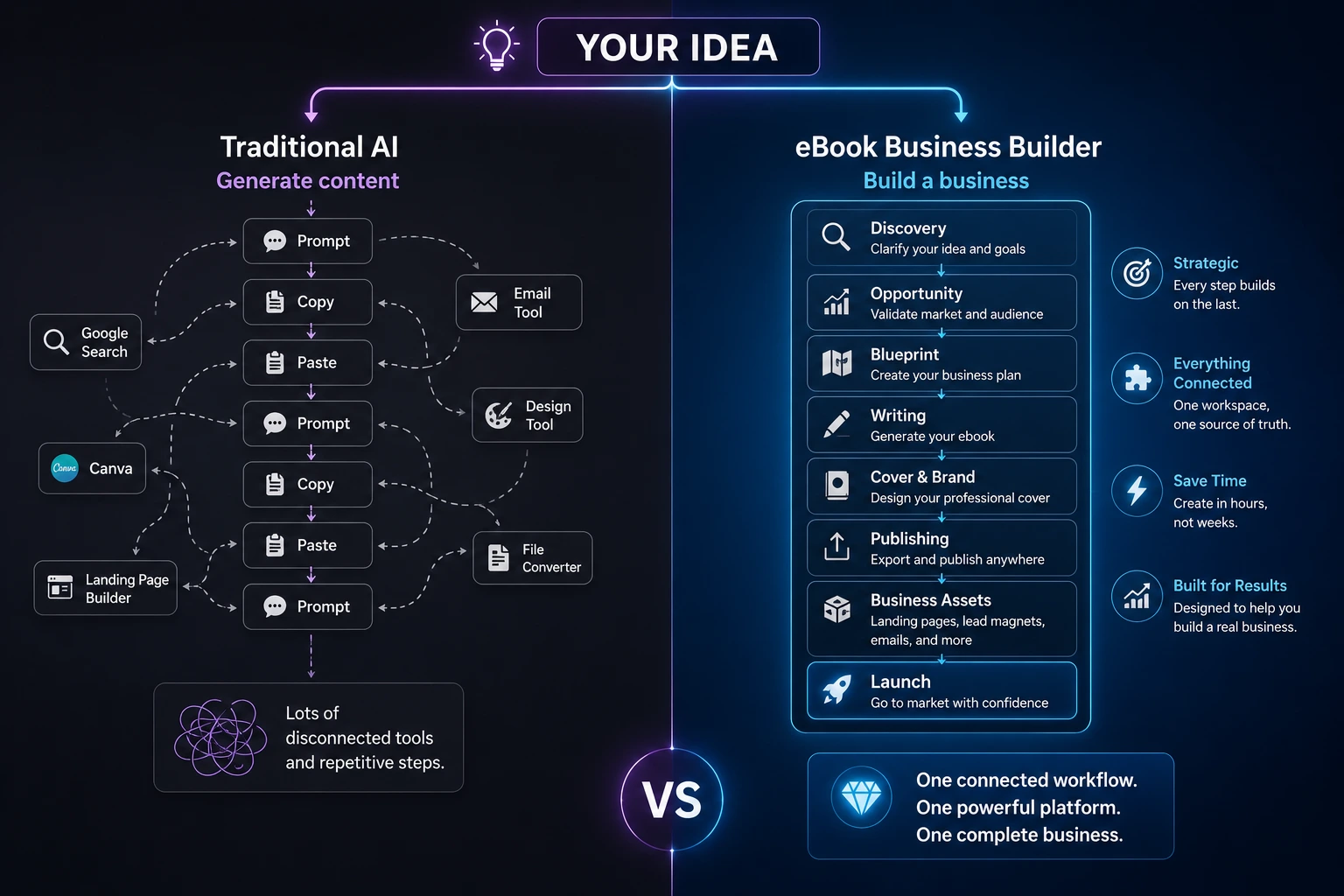
The infographic above is a visual explanation of the EBB Method—not decorative imagery, but a map of how the stages connect. It shows the contrast between a disconnected collection of separate tools—search, prompting, writing tools, email tools, design tools, landing-page tools, file converters—and the connected EBB workflow where each stage builds on the work established by the stages before it.
Launch Marketing sits at the end of that connected chain. It is meaningful because everything before it exists—and because those prior stages produced the product, assets, and strategic foundation that launch activates.
Why a Connected Workflow Matters
There is a fundamental difference between creating individual marketing pieces and building a connected business. Many creators end up with an eBook from one tool, a landing page from another, emails from a third, and social posts from a fourth—with no shared foundation connecting them.
Traditional workflows can require repeatedly moving information between separate tools: research in one place, writing in another, design somewhere else, email marketing in yet another platform, landing pages in a different builder. Each transition risks losing context—the audience definition, the problem statement, the promise, the positioning.
The EBB Method keeps the stages connected. Discovery informs Opportunity. Opportunity informs Blueprint. Blueprint informs Writing. Each stage contributes something the next stage needs. By the time you reach Launch Marketing, you are not assembling a business from unrelated parts—you are activating a system where every piece reinforces the same audience, problem, promise, and product.
That connection is what makes launch marketing more than posting about a book. You are bringing a coherent digital business to market—one where the landing page, lead magnet, emails, social content, and eBook all tell the same story.
Discovery Gives Marketing Direction
Launch Marketing connects back to every prior stage—and it begins with Discovery. The first stage established the directions worth exploring: potential ideas, audience possibilities, problems worth addressing, and areas where a product might create value.
That exploration gives marketing a starting point. You are not guessing who might be interested—you are reaching toward audiences and problems identified during Discovery. Marketing built on that foundation feels targeted rather than generic.
Without Discovery, launch marketing lacks direction—posts go everywhere, messages speak to no one, and the business struggles to find its audience. With it, marketing has a compass: the possibilities explored in Stage 1 become the audiences and problems addressed in Stage 8.
For the full picture of how Discovery opens the workflow, see eBook Discovery.
Opportunity Gives Marketing a Market
Discovery explored possibilities. Opportunity validated them—establishing the relationship between audience, demand, competition, positioning, and product potential. That validation gives marketing something concrete to work with: a defined market, not a vague hope.
Marketing becomes much stronger when it is based on a defined opportunity rather than an untested idea. You know who has the problem. You have evidence that demand exists. You understand how competitors serve the audience—and where your product can differentiate.
Launch marketing that reflects Opportunity speaks to real needs with credible positioning. It does not promise what the product cannot deliver because the opportunity was validated before the product was built.
For how Opportunity validates and defines the direction, see eBook Opportunity.
Blueprint Gives Marketing a Message
The Blueprint established the product's strategic foundation: audience, problem, transformation, product concept, structure, and content direction. Those decisions determine what the business communicates—and Launch Marketing expresses them to the market.
The marketing message should not contradict the product. It should express the value established during Blueprint:
- Who the eBook is for—the defined audience
- What problem it solves—the validated challenge
- What transformation it delivers—the before and after
- Why this approach is useful—the product concept and positioning
When marketing and product align, prospects encounter a consistent story from first social post to final page of the eBook. When they diverge, trust erodes—the landing page promises one thing, the product delivers another, and customers feel misled.
Blueprint gives marketing its message. Launch Marketing delivers that message to the audience that message was designed for. See eBook Blueprint for how the product plan is defined.
Writing Creates the Product to Market
Marketing ultimately needs something valuable to offer. Writing transformed the Blueprint into the actual eBook—the content that delivers the promised outcome to the reader.
Launch marketing promotes a real product, not a concept or a promise of future content. The manuscript exists. The chapters fulfill the transformation defined during Blueprint. The reader who buys receives substance—not a placeholder.
That matters because marketing without a product is hype. Marketing with a finished product is an invitation to experience value the business can actually deliver. Writing created that deliverable; Launch Marketing introduces it to the market.
For how Writing executes the Blueprint into a manuscript, see eBook Writing.
Cover & Brand Creates the Product Identity
The cover and brand provide the visual identity that marketing carries into the market. Before a prospect reads a word of copy, they see the cover—in a social post, on a landing page, in an email, in search results.
Product → Visual Identity → Marketing
Cover & Brand established how the product looks and feels—design choices grounded in the audience, promise, and positioning defined earlier. Launch marketing extends that visual identity into every touchpoint: social graphics, landing page design, email headers, promotional materials.
Consistent visual identity makes the business recognizable. A prospect who sees a social post and later visits the landing page should feel they have encountered the same product—not two unrelated offerings.
For how Cover & Brand presents the finished product, see eBook Cover & Brand.
Publishing Makes the Product Deliverable
Publishing created the finished product—the PDF or deliverable file the business can actually hand to a customer. Marketing can generate interest, but without a published product, there is nothing to deliver when someone decides to buy.
Creation → Finished Product → Market
Launch marketing promotes something real—a complete eBook ready for download or delivery. That readiness is what Publishing provides. The product is not "coming soon." It exists, and the business can fulfill the promise marketing makes.
For how Publishing produces the finished deliverable, see eBook Publishing.
Business Assets Create the Marketing Infrastructure
Launch Marketing is far more powerful because Business Assets already exist. Stage 7 built the infrastructure that Launch Marketing activates—not generic templates, but assets connected to the same product, audience, and promise established throughout the workflow.
Those assets include:
- Landing page — where prospects learn about and purchase the eBook
- Lead magnet — value offered in exchange for contact information
- Email sequence — ongoing communication that develops the relationship
- Social posts — content that creates visibility and drives attention
- Creator letter — personal connection between creator and audience
- Published eBook — the core product everything else supports
Attention → Landing Page → Lead Magnet → Email → Product
Launch marketing directs attention into this system. A social post creates visibility. The landing page converts interest. The lead magnet captures contacts. The email sequence nurtures prospects. The eBook is the product they ultimately purchase.
Without Business Assets, launch marketing has nothing to activate—no landing page to send traffic to, no lead magnet to offer, no email sequence to follow up. With them, launch marketing orchestrates a complete business journey. See eBook Business Assets for how that system is built.
Launch Marketing Brings Everything Together
Launch Marketing is where the complete system becomes market-facing—a connected business journey rather than isolated assets sitting in separate folders.
Consider how the pieces work together when launch activates them:
- A person discovers the business through marketing—a social post, an ad, a referral, search
- They encounter the landing page and learn what the eBook offers
- They access a lead magnet and begin a relationship with the business
- They enter an email sequence that develops trust over time
- They encounter social content that reinforces the message
- They read the creator letter and connect with the person behind the product
- They discover and purchase the eBook—the core product the entire system supports
These are not isolated assets anymore. They form a connected business journey—each touchpoint reinforcing the same audience, problem, promise, and product established from Discovery through Business Assets.
That is what Launch Marketing activates: not a book announcement, but a complete digital business entering the market.
For a practical checklist covering writing, design, marketing, and post-launch follow-up, see our complete eBook launch checklist.
Launch Is the Beginning, Not the End
Launch does not mean post once, wait, and consider the work finished. A launch creates the initial movement into the market—the first wave of visibility, engagement, and sales activity. What follows is the ongoing market-facing phase of the business.
After launch, the business can continue learning from:
- Audience response—who engages and who converts
- Questions prospects ask—revealing unmet needs or unclear messaging
- Engagement patterns—which content and channels drive attention
- Traffic sources—where interested people are finding the business
- Conversion behavior—how prospects move through the asset ecosystem
- Customer feedback—what buyers say about the product and experience
Launch begins the market-facing phase; it does not end the business. The assets built during Business Assets continue working—the email sequence keeps nurturing, the landing page keeps converting, social content keeps creating visibility. Launch Marketing sets that system in motion.
No launch guarantees specific results. Markets vary, timing matters, and execution affects outcomes. The point is structural: launch transitions the business from built to active—and everything created throughout the EBB Method is what makes that transition meaningful.
The EBB Method: From One Idea to One Complete Business
The entire eBook Business Builder Method can be read as one narrative—from a single idea to a connected digital business entering the market.
Discovery — Find the possibility.
Opportunity — Validate the opportunity.
Blueprint — Define the product.
Writing — Create the eBook.
Cover & Brand — Create the product identity.
Publishing — Produce the finished product.
Business Assets — Build the business around it.
Launch Marketing — Bring the business to market.
You start with an idea. You discover what might be worth building. You validate the opportunity. You define the product. You write the eBook. You create its visual identity. You publish the finished product. You build the business assets around it. Then you bring the complete system to market.
One idea can become more than an eBook. It can become the foundation of a complete digital business—with a product, presentation, audience capture, follow-up, promotion, and a path from first discovery to purchase.
That is the story the EBB Method tells. Launch Marketing is its final chapter—and the moment that story reaches its intended audience.
The Final Stage of the EBB Method
Launch Marketing is Stage 8—the culmination of the eBook Business Builder Method. But it is not disconnected from Stage 1. Every prior stage contributed something Launch Marketing depends on.
Idea → Discovery → Opportunity → Product → Business → Market
The entire method is designed so that each stage contributes something to the next. Discovery without Opportunity lacks validation. Opportunity without Blueprint lacks structure. Blueprint without Writing lacks content. Writing without Cover & Brand lacks presentation. Publishing without Business Assets lacks a business system. Business Assets without Launch Marketing lacks market activation.
Launch Marketing completes the loop—bringing the idea that started in Discovery to the market that Opportunity validated, through the product Blueprint defined and Writing created, with the identity Cover & Brand established, the deliverable Publishing produced, and the system Business Assets built.
This page ties the entire Guides architecture together. Each prior pillar page explains one stage. Launch Marketing explains how all eight stages converge—and what happens when a complete digital business goes to market.
Turn Your Idea Into a Digital Business
eBook Business Builder connects discovery, opportunity, blueprint, writing, cover and brand, publishing, business assets, and launch into one workflow.
Start Building with eBook Business Builder →