
Opportunity
Investigate whether your eBook idea is worth building—through demand, audience, competition, positioning, and validation.
Start Your eBook BusinessValidate and Define the Opportunity
Having an interesting eBook idea is not enough. Many promising-sounding ideas fail because they were never tested against the realities of audience need, market demand, and competitive context. Opportunity is the stage where you investigate whether an idea deserves the time and effort required to build it.
An idea becomes an opportunity when there is a meaningful connection between a specific audience, a real problem or desired outcome, existing demand, a credible product concept, and a reason the product could stand out. All five elements do not need to be perfect—but enough of them must align to justify moving forward.
This stage exists because building an eBook business takes real investment: research, writing, design, publishing, and marketing. Before committing to that work, you need evidence—not just enthusiasm.
Don't write the book first and hope the market appears afterward.
Opportunity follows eBook Discovery, where you explored what you could build. Now the question shifts: is this worth building? Discovery explores possibilities. Opportunity investigates evidence.
What Is an eBook Opportunity?
Not every eBook idea is an eBook opportunity. Understanding the difference saves you from investing in directions that sound good but lack the foundation to succeed.
Idea → Opportunity → Product
An idea is a possibility—a topic, a concept, a direction that might become something useful. It is the starting point, not the destination.
An opportunity is a possibility supported by enough evidence and clarity to justify further development. You understand who it serves, what problem it addresses, whether demand exists, and how it could differentiate from alternatives.
A product is what you eventually build from that opportunity—the finished eBook, its cover, its positioning, and the business assets around it.
Opportunity gives the idea a business context. It transforms a vague interest into a defined direction with enough specificity to evaluate, plan, and eventually build. Without this stage, you are guessing whether your eBook business idea has real potential.
Does Anyone Want This?
Demand is the natural starting point for eBook opportunity validation. Before you outline chapters or commit months to writing, you need a honest answer to a simple question: does anyone actually want this?
Demand is not a single number on a keyword tool. It is the broader pattern of need you observe when you look at what people are already trying to learn, the questions they ask, the problems they repeatedly encounter, and the solutions they seek out.
When evaluating eBook demand, consider:
- What people are actively searching for or asking about
- What problems they describe in their own words
- What solutions already exist—and whether people use them
- Whether the problem is important enough that someone would invest time and money to solve it
- Whether interest appears sustained or fleeting
Search volume can be one signal among many, but it is not proof of demand on its own. A high-volume keyword might attract browsers, not buyers. A lower-volume topic might serve a specific audience with a urgent, willingness-to-pay problem.
The goal is to understand whether a meaningful need exists—not to find a magic metric that guarantees sales. Demand research reduces the risk of building something nobody asked for.
Research the Market Before You Build
eBook market research is not an academic exercise. It is practical investigation into the environment your product would enter—what already exists, what customers expect, and where gaps might offer room for a strong product.
Useful market research can reveal:
- Existing solutions in the category—eBooks, courses, templates, and other digital products
- Competing books and their common promises
- Recurring customer problems that current solutions address poorly
- Underserved audiences whose needs are not well met
- Gaps in existing solutions—missing steps, outdated advice, overly generic content
- Opportunities for differentiation based on audience, approach, or outcome
Market research is not about copying competitors. It is about understanding the landscape so you can make informed decisions about positioning, scope, and value. When you know what is already available, you can identify where your eBook could provide something genuinely useful rather than duplicating what already exists.
Spend time reading reviews of competing products, browsing forums where your target audience discusses their challenges, and noting the language people use to describe their problems. This research grounds your opportunity in reality rather than assumption.
Who Would Actually Buy This eBook?
During Discovery, you established an audience direction—a sense of who your eBook might serve. Opportunity goes deeper. It asks not just who the audience is, but whether they have a problem serious enough to pay for a solution.
A strong eBook opportunity connects a specific audience with a meaningful problem and a desirable outcome. To evaluate that connection, explore:
- Who specifically has this problem—and how often?
- How serious is the problem for them? What does it cost them in time, money, or frustration?
- What do they want instead? What outcome would feel like success?
- What have they already tried—and why did those approaches fall short?
- What prevents them from getting the desired result on their own?
- What kind of solution are they likely to value—a quick guide, a comprehensive system, a step-by-step process?
The more precisely you can describe your ideal reader and their situation, the stronger your opportunity evaluation becomes. "Entrepreneurs" is too broad. "First-time course creators who have expertise but struggle to structure it into a sellable product" is specific enough to guide every decision that follows.
Audience → Problem → Desired Outcome → Solution
When you can articulate this chain clearly, you are moving from a general eBook idea toward a defined product opportunity with a credible reason to exist.
Understand the Competition
Competition is not automatically a reason to abandon an eBook idea. In many cases, existing products demonstrate that people already spend time, attention, or money in the category. Competition confirms that a market exists—it does not tell you whether your specific product can succeed.
When studying competitive research for your eBook opportunity, examine:
- Competing eBooks and digital products in the category
- Common positioning and promises across existing solutions
- Strengths of current offerings—what they do well
- Weaknesses or gaps—what they miss, oversimplify, or explain poorly
- Opportunities to serve the audience differently through approach, depth, or specialization
Do not assume that "no competition" automatically means a good opportunity. An empty market can indicate lack of demand rather than an untapped goldmine. The useful question is not whether competitors exist—it is whether your product can provide a meaningful alternative or improvement.
Read competitor reviews carefully. Complaints and unmet expectations often reveal the positioning angles and content gaps that your eBook could address.
How Will This eBook Be Different?
Positioning is the answer to a question every potential buyer asks, whether consciously or not: "Why this product for this audience?"
eBook positioning does not require inventing something nobody has ever done. It requires giving the right audience a clear reason to choose your particular solution over the alternatives—including doing nothing at all.
Strong positioning often emerges from a combination of:
- A specific audience—not everyone, but the right someone
- A specific problem—not a vague topic, but a concrete challenge
- A specific outcome—the result the reader can expect
- A unique angle—your perspective, method, or approach
- Practical value—a clear, actionable path rather than abstract theory
- Experience or expertise that gives your approach credibility
- Simplicity or specialization that makes the solution easier to apply
Product positioning becomes clearer when you understand both your audience and your competition. You are not trying to be everything to everyone. You are defining why this eBook matters to this reader for this problem—and what makes your approach worth their investment.
Look for the Gap
A market gap is not necessarily an empty category with zero competitors. Often, the strongest eBook opportunities exist because the current market is poorly served—not because nobody has tried to serve it.
Market gaps can take many forms:
- An underserved audience whose needs existing products ignore
- An unclear solution that leaves readers confused about what to do next
- A problem that competing products mention but never explain well
- An outdated approach that no longer matches how people work or learn
- An overly complicated solution when readers need something simpler
- A missing practical, step-by-step process
- A different desired outcome than what existing products promise
- An opportunity to make something easier, faster, or more accessible
Identifying a gap is one of the most practical outputs of opportunity research. It gives you a concrete reason why your eBook could succeed—not despite competition, but because existing options leave something important unaddressed.
When you can describe the gap clearly, you have a foundation for both your product concept and your marketing message.
Validate Before You Write
eBook idea validation means gathering enough evidence to make a better decision before committing substantial time to writing. It is one of the most valuable activities in the entire eBook business workflow—and one of the most commonly skipped.
Validation is not a single test with a pass-or-fail result. It is a collection of signals that, taken together, reduce unnecessary uncertainty about whether an idea is worth pursuing.
Forms of validation evidence include:
- Audience demand—signs that people actively seek solutions to this problem
- Search behavior—what people look for when trying to solve it
- Existing products—proof that others have built and sold in this space
- Competitor activity—what is working and what is missing
- Customer questions—recurring questions that reveal unmet needs
- Audience conversations—forums, comments, social discussions, client calls
- Willingness to pay—whether people already spend money on related solutions
- Existing purchasing behavior—sales of competing products as a market signal
- Problem severity—how much the problem costs your audience in time, money, or stress
- Strength of the desired outcome—how motivated people are to achieve the result
No combination of these signals guarantees success. Markets shift, execution matters, and timing plays a role. But validation gives you a stronger foundation than intuition alone—especially when deciding between multiple directions uncovered during Discovery.
Validation does not mean guaranteeing success. It means reducing unnecessary uncertainty.
The question is not "Can I prove this will be profitable?" It is "Do I have enough evidence to justify investing the next stage of work?" That is a much more answerable question—and one that separates promising eBook business ideas from expensive guesses.
Turn the Idea Into a Business Opportunity
By the time you complete opportunity evaluation, the original eBook idea should look substantially different from where it started. Vague interest becomes specific direction. Assumptions become evidence-informed conclusions.
Idea → Audience → Problem → Demand → Competition → Positioning → Validation → Defined Opportunity
At this point, you should be able to articulate:
- Who the product is for—a defined target audience
- What problem it addresses—a specific customer problem worth solving
- What outcome it promises—a clear desired reader outcome
- Why the problem matters—evidence that the need is real
- What alternatives already exist—competitive context
- How the product can be positioned—a reason to choose this solution
- Why the idea deserves further development—enough validation to proceed
This is the transition from possibility to plan-ready direction. You are not yet writing the eBook, but you know what you would be writing—and why it has a reasonable chance of finding an audience willing to pay for it.
How eBook Business Builder Handles Opportunity
eBook Business Builder does not jump from an initial idea straight into writing. After Discovery explores what you could build, Opportunity examines whether that direction is worth developing—using the same structured workflow that guides every stage of the process.
The Opportunity stage takes the direction uncovered during Discovery and investigates it through the lens of audience, demand, competition, positioning, and market potential. Rather than asking you to figure out market research on your own, EBB guides you through the evaluation with focused questions and structured analysis.
You examine who would buy the eBook, whether meaningful demand exists, how competitors serve the audience today, where gaps might exist, and how your product could be positioned to stand out. The process builds on everything articulated during Discovery—it does not start from scratch.
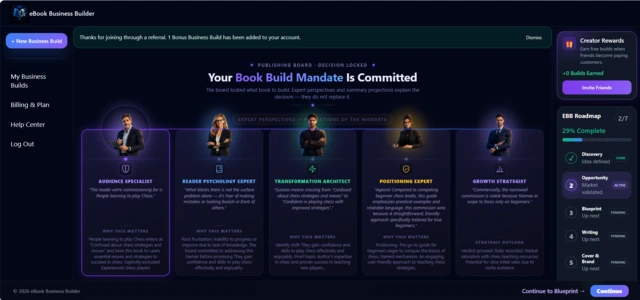
The screenshot above shows the Opportunity experience in action—structured evaluation that turns discovery output into evidence-informed product direction.
What you develop during Opportunity feeds directly into the Blueprint stage. The defined audience, validated problem, positioning direction, and product concept become the inputs for building a structured eBook plan—not a manuscript generated before you know what the product should be.
What Opportunity Produces
Opportunity does not produce a finished eBook or guarantee sales. It produces a clearer, more defined product direction—the foundation for better decision-making and a stronger Blueprint.
By the end of this stage, you should have:
- A defined target audience—not a vague category, but a specific reader profile
- A validated problem—evidence that the need is real and meaningful
- A desired reader outcome—the result your eBook will help achieve
- Market understanding—context about demand and the competitive landscape
- Competitive context—knowledge of alternatives and their strengths and gaps
- A positioning direction—a clear reason your product could stand out
- A refined product concept—specific enough to plan and build
- A clearer reason to proceed—or to pivot before investing in writing
This output is deliberately focused on decision quality, not certainty. The purpose is to give you confidence that you are building the right product for the right audience—not to promise a specific revenue outcome before you have written a word.
From Opportunity to Blueprint
The eBook Business Builder workflow moves deliberately from one stage to the next. Each stage produces inputs the following stage requires.
Discovery finds promising possibilities. Opportunity determines which direction deserves development. Blueprint turns that defined opportunity into a structured eBook product plan—the outline, content architecture, and reader transformation that guide the writing process.
Opportunity → Blueprint
Without Opportunity, a Blueprint would be built on assumptions. Without a Blueprint, writing would lack structure and direction. The workflow ensures that each stage adds clarity before the next adds complexity.
When your opportunity is defined—audience, problem, demand, positioning, and validation in place—you are ready to shape it into a product plan. Explore the eBook Blueprint →
Opportunity in the eBook Business Builder Method
Opportunity is the second stage of the eBook Business Builder Method—the complete workflow for turning one idea into a published eBook and a functioning digital business.
It follows Discovery, where you explored what you could build, and precedes Blueprint, where you structure the product you will create.
Discovery → Opportunity → Blueprint → Writing → Cover & Brand → Publishing → Business Assets → Launch Marketing
Each stage builds on the one before it. Discovery opens the process by exploring possibilities. Opportunity validates and defines the strongest direction. Blueprint, Writing, and the stages that follow turn that direction into a complete digital business.
If you have not yet completed Discovery, start there to establish the directions worth evaluating. Return to eBook Discovery →
Next Step: Blueprint
Once the opportunity is clear, the next challenge is turning that opportunity into a product that can actually be built. You know who it serves, what problem it addresses, and why it could succeed—but you still need structure: chapters, sections, reader outcomes, and a content plan.
That is the purpose of the Blueprint stage—translating a defined opportunity into a concrete eBook product plan ready for writing.