
Business Assets
Turn your published eBook into a complete digital business—landing page, lead magnet, email sequence, social posts, and the system that helps people discover, understand, and buy your product.
Start Your eBook BusinessBuild the Business Around Your eBook
Creating a good eBook is only one part of building an eBook business. A finished product—complete manuscript, professional cover, published PDF—still needs a way to attract attention, explain its value, capture interested prospects, follow up with potential customers, generate sales, and continue communicating with its audience.
That is what Business Assets provide. This is Stage 7 of the eBook Business Builder Method—the point where the workflow expands beyond creating an eBook and builds the surrounding business system.
The eBook is the product. The business assets create the system around the product.
eBook Business Builder does not stop when the eBook is written. It continues by creating the assets around the product—so you are not left with a PDF and no way to sell it. You are building the beginnings of a digital business around what you created.
eBook → Landing Page → Lead Magnet → Email Sequence → Social Posts → Business System
This page is where the EBB workflow becomes particularly distinctive. Earlier stages built the product. Business Assets build the infrastructure that connects that product to customers.
What Are eBook Business Assets?
eBook business assets are the supporting digital resources that help an eBook business attract, convert, communicate with, and serve an audience. They are not the product itself—they are the system that makes the product discoverable, understandable, and purchasable.
In eBook Business Builder, the business asset ecosystem includes:
- Landing Page — where prospects learn about the eBook and decide to buy
- Lead Magnet — valuable content that captures interest before purchase
- Email Sequence — ongoing communication that develops the relationship
- Social Posts — content that creates visibility and drives attention
- Creator Letter — a personal connection between creator and audience
- Published eBook — the core product everything else supports
Together, these assets form an interconnected system—not a folder of unrelated marketing files. Each asset has a defined role, and each is built around the same product, audience, and promise established throughout the EBB Method.
Why an eBook Alone Is Not a Business
A person can write an excellent eBook and still have no effective business around it. The product exists—but nothing connects it to the people who would benefit from it or pay for it.
Consider what is missing when you have a product but no business assets:
- Product without presentation — difficult for prospects to understand what the eBook offers and why it matters
- Product without audience capture — difficult to build relationships with people who show interest but are not ready to buy
- Product without follow-up — missed opportunities when interested visitors leave and never return
- Product without promotion — difficult to reach the people who need what you created
The goal is not simply to create more content for its own sake. The goal is to create the infrastructure around the product—the landing page that presents it, the lead magnet that captures interest, the email sequence that nurtures prospects, the social posts that create visibility.
Business Assets is the stage where that infrastructure takes shape—built from the same strategic foundation as the eBook itself, not assembled from generic templates disconnected from your product.
The eBook Business Asset Ecosystem
The business assets work as a connected system—not isolated deliverables, but parts of a flow that moves someone from unaware to interested to customer.
eBook → Landing Page → Lead Magnet → Email Sequence → Social Posts → Audience → Interest → Relationship → Purchase
Each asset plays a distinct role in that flow:
- The eBook is the core product—the value customers pay for
- The landing page presents the product and converts interest into action
- The lead magnet offers value upfront and captures contact information
- The email sequence continues the conversation and develops trust over time
- The social posts create opportunities for discovery and drive attention toward the business
This connected ecosystem is one of the most important distinctions in the EBB workflow. Many tools help you write an eBook. Business Assets is where eBook Business Builder helps you build the business around it—a system where each piece reinforces the same audience, problem, promise, and product.
The Landing Page
The landing page gives the eBook a dedicated place where a prospective customer can understand the product and decide whether to buy. It is the bridge between traffic and purchase—the page someone lands on when they click a link, see an ad, or follow a social post.
An effective eBook landing page communicates:
- What the eBook is and what it covers
- Who it is for—the intended audience
- What problem it addresses
- What transformation or value it offers
- Why it is worth considering—positioning that distinguishes it from alternatives
The landing page connects the product to the prospective customer. Without it, you have an eBook with no clear place to send interested people. With it, you have a presentation layer that turns curiosity into consideration—and consideration into purchase.
In EBB, the landing page is built around the same audience, problem, and promise defined during Discovery, Opportunity, and Blueprint—not a generic template disconnected from your product. For deeper guidance on landing page design, see our guide to eBook landing pages.
The Lead Magnet
Not everyone who discovers an eBook is ready to buy immediately. They may need more information, more trust, or more time. A lead magnet gives the business a way to offer useful value while beginning a relationship with a potential customer.
The progression is straightforward:
Visitor → Lead Magnet → Interested Prospect
A lead magnet might be a checklist, a short guide, a template, or another resource related to the eBook's topic—something valuable enough that a visitor willingly provides their email address to receive it. In exchange, the business gains permission to continue the conversation.
The lead magnet becomes the bridge between traffic and the eventual eBook purchase. It captures people who are interested but not yet committed, giving the email sequence an audience to nurture toward the full product.
The Email Sequence
Once someone becomes interested—often by downloading a lead magnet—the email sequence takes over. It continues the conversation on a schedule the business controls, rather than hoping a visitor remembers to return on their own.
An email sequence can:
- Continue the conversation started by the lead magnet
- Provide useful information related to the reader's problem
- Reinforce why the problem matters and why solving it is worth the effort
- Explain the value of the eBook as a complete solution
- Introduce the product when the reader is ready to hear about it
- Encourage the next action—visiting the landing page, considering the purchase
The key point: the business does not have to rely on a visitor remembering to come back. The email sequence creates an ongoing communication path—a relationship that develops over days or weeks rather than a single visit that may never repeat.
Email works best when it serves the same audience and addresses the same problem as the eBook. Disconnected sequences feel like generic marketing. Connected sequences feel like a natural extension of the product's promise.
The Creator Letter
The Creator Letter adds a personal dimension to the business asset ecosystem—a direct communication from the creator to the audience that goes beyond product description.
A creator letter can communicate:
- Why the product was created
- The creator's perspective on the problem the eBook addresses
- The motivation behind building this particular resource
- A more personal introduction to the product and its purpose
In a digital product business, personal connection can differentiate your offer from generic alternatives. The Creator Letter gives prospects a sense of who stands behind the eBook—not just what it contains, but why it exists and who created it.
Within the EBB workflow, the Creator Letter appears alongside the other business assets as part of the author ecosystem—one more element that connects the product to a human creator rather than presenting an anonymous PDF for sale.
How eBook Business Builder Creates the Business Assets
After Publishing produces the finished eBook, Business Assets is where eBook Business Builder creates the surrounding system—landing page, lead magnet, email sequence, social posts, creator letter, and the published book together in one Author Ecosystem.
The assets are built from the same product context established throughout the workflow: the audience, problem, promise, and positioning defined during earlier stages inform how each asset is created. You are not starting from scratch for every piece of marketing material.
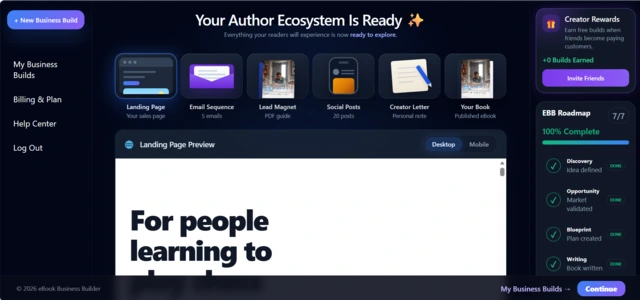
The screenshot above shows the Business Assets stage within EBB—the Author Ecosystem with landing page, email sequence, lead magnet, social posts, creator letter, and published eBook visible together. This is evidence of the actual product workflow: one finished eBook, multiple connected business assets, organized as a system rather than scattered files.
You don't just create an eBook. You build the business around it. The interface reflects that distinction—product and business assets side by side, connected by the same strategic foundation.
One Product, Multiple Business Assets
One of the most powerful aspects of the Business Assets stage is that the same underlying eBook informs every asset in the ecosystem. The creator is not starting from scratch for each piece of marketing material—the assets are built around the same product and audience.
- The eBook provides the core knowledge and the product customers buy
- The landing page presents that product to prospective customers
- The lead magnet introduces value related to the eBook before purchase
- The email sequence develops the relationship toward the full product
- The social posts create opportunities for discovery and attention
- The creator letter adds personal connection to the product and its creator
This is a content-to-business transformation. The strategic work done during Discovery, Opportunity, Blueprint, Writing, Cover & Brand, and Publishing does not disappear—it propagates into every business asset. The audience defined during Blueprint is the same audience the landing page speaks to. The problem validated during Opportunity is the same problem the lead magnet addresses. The promise established early in the workflow is the same promise the email sequence reinforces.
That coherence is what makes the Author Ecosystem more than a collection of files. It is a business system where every asset tells the same story.
Why Connected Assets Matter
Without a connected system, a creator may end up with an eBook in one place, social posts somewhere else, an unrelated landing page, a generic email sequence, and no lead magnet at all. The result feels fragmented—each piece created independently, with no shared foundation.
A connected system allows every asset to reinforce the same:
- Audience—the reader the business serves
- Problem—the challenge the product addresses
- Promise—the outcome the eBook delivers
- Positioning—the reason to choose this product
- Product—the eBook at the center of the ecosystem
This connects directly back to the earlier EBB stages. Discovery explored who you could serve. Opportunity validated the direction. Blueprint defined the product. Writing, Cover & Brand, and Publishing created and delivered it. Business Assets extends that same foundation into the marketing and sales infrastructure.
When assets are disconnected, prospects encounter mixed messages—a social post about one topic, a landing page about another, an email sequence that feels generic. When they are connected, every touchpoint reinforces the same value proposition. That consistency builds trust and makes the path from interest to purchase clearer.
From Content Creation to Business Creation
There is a meaningful shift that happens at the Business Assets stage—a transition from building content to building a business.
Writing an eBook is content creation. Building the assets around it is business creation. That is the point where eBook Business Builder moves beyond being simply an eBook writing tool and becomes a business-building workflow.
After Business Assets, the creator has:
Product + Presentation + Audience Capture + Follow-Up + Promotion
That combination is the foundation of a digital business—not a manuscript waiting for someone to figure out how to sell it, but a system with a product at its center and infrastructure around it.
This distinction matters for how you think about the EBB Method. Stages one through six build the product. Stage seven builds the business around the product. Stage eight—Launch Marketing—brings that complete system to market. Each stage adds a layer the previous stage could not provide alone.
What Business Assets Can Do for the eBook
Each asset in the ecosystem serves a specific function. Together, they create a complete path from discovery to purchase.
- Landing Page — presents the product and converts interest into action
- Lead Magnet — captures interest from visitors not yet ready to buy
- Email Sequence — develops the relationship and nurtures prospects over time
- Social Posts — create visibility and drive attention toward the business
- Creator Letter — adds personal connection between creator and audience
- eBook — provides the core product customers pay for
The important point is not any single asset—it is that these assets work together. A landing page without traffic sources has no visitors. Social posts without a landing page have nowhere to send interested people. A lead magnet without an email sequence captures contacts with no follow-up. Each asset needs the others to function as a system.
Business Assets produces that system—connected, coherent, and built around the same product foundation established throughout the EBB Method.
Business Assets as the Seventh Stage of the EBB Method
Business Assets is the seventh stage of the eBook Business Builder Method—the complete workflow for turning one idea into a published eBook and a functioning digital business.
Discovery → Opportunity → Blueprint → Writing → Cover & Brand → Publishing → Business Assets
Each stage answers a distinct question:
- Discovery: What could I build?
- Opportunity: Is this worth building?
- Blueprint: What exactly should I build?
- Writing: How do I turn the plan into the actual eBook?
- Cover & Brand: How do I present the finished product professionally?
- Publishing: How do I turn it into a finished digital product?
- Business Assets: What does the business need around the product?
Business Assets is not an unrelated collection of marketing tools bolted onto a finished eBook. It is the next logical stage after Publishing—the point where a finished product gets the business infrastructure it needs to reach customers.
If your eBook is not yet published, complete Publishing before building business assets around a product that does not yet exist. Return to eBook Publishing →
Next Step: Launch Marketing
The business now has a product and the assets that support it—a landing page, lead magnet, email sequence, social content, and a creator connection. The Author Ecosystem is in place. The next question is: how do you bring this complete system to market?
Launch Marketing is the final stage of the EBB Method—the point where promotion, traffic, and launch strategy activate the business you have built. The product exists. The assets exist. Launch Marketing connects them to the audience that needs them.
Social Media Posts
Social posts give the business material that can help bring attention to the problem, the audience, useful ideas, the eBook, the landing page, and the broader business. They create visibility—the top of the funnel where people first encounter what you have built.
Each asset in the ecosystem plays a different role:
Social content is not a replacement for a landing page or email strategy—it is the entry point that feeds them. A post might highlight a common mistake the eBook helps readers avoid, share a tip from the content, or point toward the lead magnet. The post creates the opportunity; the other assets convert it.
When social posts align with the same audience, problem, and promise as the eBook, they feel coherent rather than random—part of a system rather than isolated content.