
Blueprint
Turn a validated opportunity into a structured eBook plan—audience, transformation, chapters, and content architecture—before writing begins.
Start Your eBook BusinessBuild the eBook Blueprint
Once an opportunity has been defined, a new question takes center stage: what exactly should the product be? You know the direction is worth pursuing—but the eBook itself still needs shape, structure, and purpose before a single chapter is written.
An eBook blueprint turns the defined opportunity into a structured product plan. It answers not whether to build, but what to build and how the parts fit together to serve the reader.
Discovery asks: "What could I build?"
Opportunity asks: "Is this worth building?"
Blueprint asks: "What exactly should I build?"
Opportunity tells you what is worth building. Blueprint tells you what to build. Writing comes after the blueprint—it is the execution of a plan, not the place where you figure out what the book should be.
The blueprint gives the eventual manuscript a clear purpose, audience, structure, and direction. Without it, writing becomes improvisation—and improvisation is expensive when it produces chapters that do not belong.
What Is an eBook Blueprint?
An eBook blueprint is the plan that connects every strategic element of the product before writing begins. It is the document—or structured thinking—that links audience, problem, desired outcome, product concept, content, chapters, and reader transformation into one coherent product design.
A blueprint is more than a table of contents. A list of chapter titles tells you what sections exist. A blueprint explains how those sections work together to create a useful experience for the reader—why each part exists, what it accomplishes, and how the whole book delivers on its promise.
When you create an eBook blueprint, you are designing the product, not yet producing it. You define who the book serves, what problem it solves, what the reader should be able to do or understand afterward, and how the content moves them from where they are to where they want to be.
This is eBook planning at its most practical: a content plan and writing plan combined into a single strategic foundation for the manuscript.
Why an eBook Needs a Blueprint
Many writers jump directly from an idea into drafting chapters. The enthusiasm is understandable—but the results often are not. Without a blueprint, writing tends to drift.
Common problems when you skip eBook planning include:
- Disconnected chapters that do not build on each other
- Repetition—the same point made in multiple places without adding value
- Unclear purpose—the reader never quite knows what the book is trying to accomplish
- Weak progression—content that does not move logically from start to finish
- Unnecessary content—sections included because they seemed interesting, not because they serve the reader
- Inconsistent reader experience—tone, depth, and focus that shift without reason
- Difficult revisions—restructuring a finished manuscript is far harder than planning well upfront
- A manuscript that grows longer without becoming more useful
Planning before writing reduces wasted writing.
The blueprint gives the writer a clear destination before the manuscript begins. Every chapter has a reason to exist. Every section contributes to an outcome the reader can feel. That is what separates a structured eBook from a collection of loosely related notes.
From Opportunity to Product
Blueprint sits at a specific point in the eBook Business Builder workflow—the moment when a validated direction becomes a concrete product design.
Discovery → Opportunity → Blueprint
Discovery identifies promising possibilities. Opportunity determines which direction deserves development through demand, audience, competition, and validation. Blueprint converts that defined opportunity into a specific product with structure, chapters, and a clear reader transformation.
The Blueprint should build on the work already done—not invent an unrelated new idea. The audience you validated during Opportunity becomes the reader you design for. The problem you confirmed becomes the problem your chapters address. The positioning you identified shapes how the product concept takes form.
If you have not yet defined your opportunity, return to that stage before building a blueprint on uncertain ground. Explore the Opportunity stage →
Define the eBook Audience
Blueprint takes the audience understanding from Opportunity and makes the intended reader more concrete. During planning, vague categories are not enough—you need a reader profile specific enough to guide every content decision.
Define your target audience and ideal reader by answering:
- Who is the reader—what is their situation, role, or background?
- What do they already know about this topic?
- What are they struggling with right now?
- What do they want to accomplish?
- What do they need to learn to get there?
- What would make this eBook genuinely useful to them—not generic, but specifically relevant?
Reader needs and the audience problem should anchor every section of the blueprint. You are not organizing content around a topic alone. You are designing a product for a person with a specific challenge and a desired reader outcome.
The blueprint should always be created for a reader, not simply around a subject. When you know who you are writing for, decisions about depth, examples, tone, and scope become much clearer.
Define the Reader's Problem
A broad topic and a specific problem are not the same thing—and conflating them is one of the most common blueprint mistakes.
Consider the difference:
- Topic: Home fitness
- Product problem: Helping busy beginners create a simple strength-training routine they can follow consistently at home
The topic is a category. The problem is what the reader cannot do, understand, or achieve without help. The problem gives the eBook a reason to exist—it defines why someone would invest time and money in your product rather than searching randomly or doing nothing.
Before deciding what content belongs in the book, the blueprint should make the problem explicit. What friction does the reader face? What have they tried? What outcome remains out of reach? When the problem is clear, irrelevant content becomes easier to exclude and essential content becomes easier to identify.
Define the Transformation
Every strong eBook promises a change. The reader starts in one state and finishes in another—more informed, more capable, more confident, or closer to a goal. Defining that transformation is one of the most important parts of eBook planning.
BEFORE → AFTER
Ask clearly: what should be different for the reader after completing this eBook?
The before state might be confusion, frustration, inaction, or repeated failure. The after state is what they can now do, understand, decide, or accomplish. A meaningful reader transformation gives the entire book a north star—every chapter should move the reader closer to that outcome.
The blueprint connects transformation to content through a simple chain:
Audience → Problem → Transformation → Content
When you know where the reader needs to end up, you can work backward to determine what they need to learn, practice, or understand along the way. That backward planning is what makes an eBook outline strategic rather than arbitrary.
Build the eBook Concept
The eBook concept is where the major planning elements converge into a product definition specific enough to guide the outline and eventual manuscript.
Topic + Audience + Problem + Desired Outcome = eBook Concept
When these elements combine, the result should be specific enough that any reader—or reviewer—can immediately understand:
- Who the eBook is for
- What it helps them accomplish
- Why the product exists
- What makes the approach useful
A weak concept sounds like "a book about marketing." A strong concept sounds like "a step-by-step guide for first-time course creators who need to structure their expertise into a sellable digital product within 30 days." The second version tells you who, what, and why—and it practically writes its own outline.
The eBook concept becomes the foundation for chapter planning, content structure, and every writing decision that follows.
Create the eBook Outline
The eBook outline is the structural map of the book—the sequence of chapters and major sections that carry the reader from problem to transformation. Creating an outline is where eBook structure becomes visible and testable before any prose is written.
A good outline should show more than chapter titles. For each major section, it should communicate:
- What the chapter accomplishes
- Why the chapter exists in this position
- How it relates to the chapters before and after it
- How the reader progresses through it
- How the overall book reaches the promised outcome
Do not reduce the outline to a list of headings. The logic of the book matters as much as the labels. When you outline an eBook well, you can read the structure alone and understand the journey the reader will take.
Book outline quality directly affects writing efficiency. A clear eBook chapter outline tells the writer what to produce in each session and how each piece fits the whole—eliminating the paralysis of deciding what comes next while drafting.
Structure the Chapters
Every chapter in the blueprint should have a purpose—not just a title. Chapter planning is where eBook organization moves from abstract structure to actionable design.
For each chapter, consider:
- What does the reader need to understand in this chapter?
- What problem does this chapter solve—or what part of the larger problem does it address?
- What should the reader know or be able to do afterward?
- How does this chapter prepare the reader for what comes next?
Good eBook chapter structure creates progression rather than a collection of disconnected information. Early chapters establish foundations. Middle chapters build capability. Later chapters apply, integrate, or advance toward the final transformation.
When chapter outlines include purpose and outcome—not just topics—the writer knows what success looks like for each section. That clarity prevents chapters that feel complete but contribute nothing to the reader's journey.
Build the Content Architecture
An outline shows what comes where. Content architecture explains how the pieces work together within and across chapters—the internal logic that creates a coherent reader experience.
Content architecture varies by subject, but many effective eBook sections follow a progression such as:
Problem → Principle → Explanation → Example → Application → Next Step
This pattern is not mandatory—it is illustrative. The point is that each part of the eBook should have a reason for being there. An explanation without an example may leave readers unsure how to apply what they learned. An application without a stated principle may feel arbitrary.
eBook content structure and eBook organization are strategic choices. The blueprint should describe not only which topics appear in which chapters, but how information flows within them—so the reader builds understanding step by step rather than absorbing isolated facts.
When content architecture is defined upfront, writing becomes assembly of planned components rather than discovery of structure mid-draft.
Connect Every Chapter to the Transformation
The ultimate test of any blueprint element is a single question: does this chapter move the reader closer to the promised outcome?
Content should earn its place in the book. If a chapter does not help solve the problem, teach necessary knowledge, or advance the reader toward the desired transformation, it may not belong—no matter how interesting the topic seems.
This discipline is what separates a strategic product plan from a mere outline. A table of contents can list anything. A blueprint includes only what serves the reader's journey from before to after.
During planning, review each chapter against the transformation defined earlier. Ask whether removing it would weaken the reader's ability to reach the outcome. If the answer is no, consider cutting or merging it. If the answer is yes, ensure the chapter's purpose in the blueprint is explicit enough to guide the writing stage.
Connecting every chapter to the transformation keeps the eBook focused, useful, and aligned with the reason someone would buy it in the first place.
How eBook Business Builder Creates the Blueprint
eBook Business Builder moves from Opportunity into Blueprint rather than immediately generating a manuscript. After Discovery explores possibilities and Opportunity validates the direction, Blueprint turns that defined opportunity into a structured plan for the eBook.
The Blueprint stage takes everything developed so far—the audience, problem, demand context, positioning, and product concept—and organizes it into a coherent product design. Audience becomes reader profile. Problem becomes chapter purpose. Transformation becomes the outcome every section serves.
EBB guides you through eBook planning with structured questions and outputs: the product concept, chapter direction, content architecture, and the writing strategy that will execute the plan. You are designing the book before producing it.
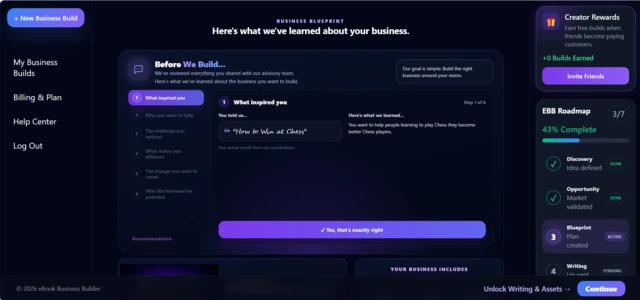
The screenshot above shows the Blueprint experience in action—turning a validated opportunity into a structured product plan rather than jumping straight to generated content.
What you develop during Blueprint gives the Writing stage a clear plan to execute. The strategic decisions are made. The writer can focus on creating useful content for the intended reader—not on figuring out what the book should be.
What an eBook Blueprint Produces
The Blueprint stage does not produce a finished manuscript or guarantee a successful book. It produces a clear product plan—the foundation that makes writing deliberate rather than exploratory.
By the end of Blueprint, you should have:
- A defined reader—specific enough to guide tone, depth, and examples
- A defined problem—the reason the eBook exists
- A reader transformation—the before and after the book delivers
- A product concept—the integrated definition of who, what, and why
- eBook structure—the overall architecture of the book
- Chapter direction—purpose and outcome for each major section
- Content architecture—how information flows within and across chapters
- A writing strategy—how to execute the plan in the Writing stage
The result is a product plan that can be turned into a manuscript with confidence. Every hour spent in Blueprint saves multiples in writing and revision—because the writer knows exactly what they are building and why each part matters.
Blueprint Is the Bridge to eBook Writing
The transition from planning to production should feel natural—not a leap into the unknown, but the execution of a design already completed.
Opportunity → Blueprint → Writing
Writing should not be where you decide what the eBook is about. By the time writing begins, the important strategic decisions should already have been made: the audience, the problem, the transformation, the structure, and the chapter purposes.
The writer can now focus on execution—creating clear, useful content for the intended reader. That is a fundamentally different task from discovering the book while writing it, and it produces fundamentally better results.
Blueprint is the plan. Writing is the execution of that plan. Keeping this distinction clear prevents the common trap of using the drafting process as a substitute for product design.
When your blueprint is complete, you are ready to produce the manuscript. Explore eBook Writing →
Blueprint in the eBook Business Builder Method
Blueprint is the third stage of the eBook Business Builder Method—the complete workflow for turning one idea into a published eBook and a functioning digital business.
It follows Opportunity, where you validated the direction, and precedes Writing, where you create the manuscript.
Discovery → Opportunity → Blueprint → Writing → Cover & Brand → Publishing → Business Assets → Launch Marketing
Each stage builds on the one before it. Discovery explores possibilities. Opportunity investigates evidence and defines the opportunity. Blueprint turns that opportunity into a structured product plan. Writing, Cover & Brand, Publishing, and the stages that follow bring the plan to market.
If your opportunity is not yet defined, complete that stage before building a blueprint. Return to eBook Opportunity →
Next Step: Writing
Once the opportunity is defined and the eBook blueprint is complete, the next stage is turning that plan into the actual manuscript. The strategic work is done. The structure is set. Now the focus shifts to creating the content that delivers on the promise.
Writing executes the blueprint—chapter by chapter, section by section—until the reader transformation you designed becomes real prose.