Publishing
Turn your completed manuscript and cover into a finished, deliverable digital product—ready to download, distribute, and build a business around.
Start Your eBook BusinessPublish the eBook
Publishing is the stage where the completed eBook becomes a finished, deliverable product. The major creative work has already happened—the opportunity identified, the market validated, the product planned, the manuscript written, the cover and visual identity created. Publishing brings those pieces together into something a reader can actually receive.
Writing creates the manuscript. Cover & Brand gives it a professional identity. Publishing turns the completed work into a finished product that can be delivered to readers.
In the eBook Business Builder Method, the key question at this stage is straightforward: is the eBook ready to become a finished product? When the answer is yes, Publishing produces the deliverable—the formatted digital file that moves the workflow from creation toward delivery and business building.
This is not primarily a guide to publishing on Amazon or any specific marketplace. It is the Publishing stage of the EBB Method—the point where a planned, written, and presented product becomes something ready to hand to a reader or customer.
What Is eBook Publishing?
eBook publishing is the process of preparing a completed eBook so it can actually be delivered to readers. It is the transition from work-in-progress to finished product—the stage where content, cover, and product information come together in a final format ready for distribution or sale.
Depending on your business model, publishing can involve:
- Preparing the final file in an appropriate digital format
- Ensuring the manuscript is complete and reviewed
- Including the selected cover in the finished product
- Including appropriate author and product information
- Generating the final digital document
- Making the product ready for distribution or direct sale
Publishing does not automatically mean listing on Kindle, Amazon, or any specific marketplace. Those are distribution choices that come after—or alongside—the work of producing a finished product. Publishing, in the EBB Method, means the eBook exists as a complete, deliverable digital good.
From Manuscript to Finished Product
One of the most important distinctions in the eBook Business Builder workflow is the difference between a manuscript and a finished eBook product.
A manuscript is the written content—the chapters, explanations, and examples produced during Writing. It is the intellectual core of the product, but it is not yet something a customer receives.
A finished eBook product combines:
Content + Cover + Product Information + Final Format
This is where the EBB Method moves from creation toward delivery. Discovery through Cover & Brand built the product. Publishing assembles and formats it into something deliverable—a concrete file a reader can download, receive, or purchase.
Without this stage, you have content waiting to become a product. With it, you have a product ready to move into distribution and the business system that supports it.
What Does an eBook Need Before Publishing?
Before an eBook is ready to publish, several elements should be in place. The exact requirements vary depending on where and how the eBook will be distributed—but the core components remain consistent across business models.
Before publishing, you should have:
- A completed manuscript with final chapter structure
- A selected cover that represents the product professionally
- Author information appropriate for the finished product
- Consistent presentation—content and cover aligned with the product identity
- A final digital format suited to your delivery method
In the EBB workflow, these elements are produced across earlier stages. Writing delivers the manuscript. Cover & Brand delivers the cover and visual identity. Publishing verifies completeness and generates the finished file.
If any of these elements are incomplete, return to the appropriate stage before publishing. A finished product requires finished inputs. Return to Cover & Brand →
Preparing the Final eBook
The final eBook document should be treated as a product—not simply an exported text file. Readers who pay for a digital product expect completeness, consistency, and professional presentation.
Preparing the final eBook involves attention to:
- Completeness — all chapters present, no placeholder content remaining
- Consistency — formatting, terminology, and tone aligned throughout
- Readable formatting — structure that works in the delivery format
- Correct cover — the selected cover included in or paired with the product
- Correct author information — name and details appropriate for publication
- Final review — a last check before the product is locked for delivery
- Appropriate file format — a format that works for how the eBook will be delivered
This preparation is what separates a professional digital product from a document someone happened to save as a PDF. The goal is a finished file you would confidently deliver to a paying customer.
eBook File Formats
Digital publishing formats exist because different delivery methods have different requirements. EPUB works well for reflowable text on e-readers. MOBI and AZW serve Kindle ecosystems. PDF preserves fixed layout and works across virtually any device.
The practical principle is simple: the format needs to work for your intended method of delivery.
If you sell directly from your website, PDF is often the most straightforward choice—universally readable, easy to deliver via download, and familiar to customers purchasing digital guides and resources. If you distribute through a marketplace, that platform may specify its own format requirements.
In eBook Business Builder, Publishing produces a professionally generated PDF—the finished digital product shown in the workflow. EBB is not a multi-format publishing platform for every marketplace. It produces the core deliverable—a complete PDF combining manuscript, cover, and product information—that can be downloaded, delivered, and used as the foundation for your eBook business.
Choosing the right format for distribution beyond EBB is a business decision that comes after the product itself is complete.
Why the Final PDF Matters
A professionally generated PDF gives the creator something concrete—a finished product file that exists independently of any platform, marketplace, or ongoing subscription.
With a completed PDF, you can:
- Download and store the finished product
- Deliver it directly to customers via email or download link
- Distribute it through your own sales channels
- Use it as the core digital product your business is built around
The PDF is not an interim step—it is the deliverable. In the EBB workflow, it represents the moment when all prior stages converge: the manuscript from Writing, the cover from Cover & Brand, and the product information accumulated throughout the process, assembled into one professional document.
Having a concrete finished file changes how you think about the project. You are no longer building—you have built. The product exists. What remains is the business system around it: landing pages, funnels, marketing, and distribution—the stages that follow Publishing in the EBB Method.
Publishing Is More Than Exporting a File
Generating a PDF is technically straightforward. Click a button, receive a file. But Publishing in the EBB Method represents something larger than that action.
Publishing marks the transition from planned product to finished product. Everything before this stage was preparation—exploring, validating, planning, writing, presenting. Publishing is the confirmation that the product is complete and ready for what comes next.
Planned product → Finished product
The important thing is not the button—it is the readiness. Is the manuscript complete? Is the cover selected? Is the product information accurate? Does the final document represent the product you set out to build during Discovery?
When those conditions are met, Publishing produces the deliverable. When they are not, rushing to export creates a finished file that is not a finished product—and that gap becomes visible the moment a customer opens it.
How eBook Business Builder Handles Publishing
eBook Business Builder brings the completed manuscript, selected cover, and product information together in the Publishing stage—generating a professional PDF ready to download.
The Publishing interface reflects what the workflow has produced: the finished eBook with its chapter count, page count, cover, author information, and readiness status. When the product is complete, you download the PDF—the concrete output of every prior stage.
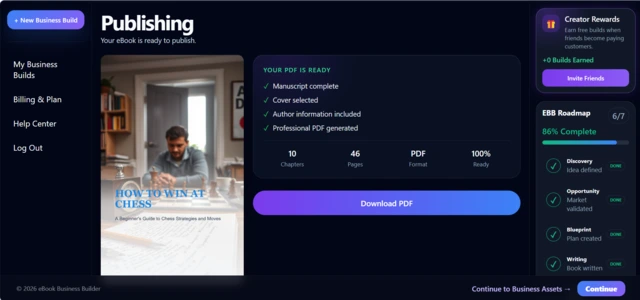
The screenshot above shows Publishing within the EBB workflow—a completed eBook with manuscript, cover, product details, and a Download PDF action. Chapter count, page count, format, and readiness status confirm the product is complete before delivery.
Nothing in this stage invents new product decisions. Publishing assembles and formats what Discovery, Opportunity, Blueprint, Writing, and Cover & Brand already established.
The EBB Publishing Workflow
The Publishing stage follows a clear sequence within eBook Business Builder—each input produced by an earlier stage, combined into a finished deliverable.
Writing → Cover & Brand → Publishing
The workflow within Publishing:
- The manuscript is completed during Writing
- The cover is selected during Cover & Brand
- Product information—including author details—is included
- The final PDF is generated, combining content, cover, and metadata
- The eBook becomes ready to deliver via download
This is the practical culmination of the first six stages of the EBB Method. Discovery found the possibility. Opportunity validated it. Blueprint defined the product. Writing created the content. Cover & Brand created the presentation. Publishing produces the file a reader actually receives.
From here, the focus shifts from building the product to building the business around it—Business Assets, then Launch Marketing.
Publishing and Distribution Are Different
An important distinction keeps the Publishing stage clear: publishing and distribution are related, but they are not the same thing.
Publishing means preparing and producing the finished product—the complete, formatted digital file ready for delivery.
Distribution means getting that product into the channels where readers can obtain it—your website, an email delivery system, a marketplace, or other sales channels.
Generating a PDF does not automatically mean the eBook has been distributed everywhere. It means the product exists in a deliverable form. How and where you make it available is a separate set of decisions—ones that Business Assets and Launch Marketing address in later stages.
Confusing publishing with distribution leads to a common mistake: believing the work is done once a file is exported, when in reality the business system that sells and delivers the product still needs to be built.
Direct Sales vs. Publishing Platforms
Once you have a finished eBook product, you can deliver it through different business models. The EBB Method's role at the Publishing stage is to produce that product—not to dictate where you sell it.
Common delivery approaches include:
- Direct sales — selling from your own website, with the PDF delivered via download link or email
- Publishing platforms — listing on marketplaces such as Amazon Kindle, Apple Books, or similar services
- Multiple channels — combining direct sales with platform distribution for broader reach
Each model has different requirements, economics, and marketing implications. Platform publishing may require format conversion, metadata submission, and compliance with marketplace guidelines. Direct sales give you full control over pricing, delivery, and customer relationship.
This page is not a tutorial for any specific platform. The EBB Method produces the finished digital product—the PDF—that can move into whichever distribution system you choose. Business Assets and Launch Marketing build the system around that product, whether you sell directly or through additional channels.
A Published eBook Becomes a Business Asset
Once the eBook exists as a finished product, it becomes the foundation for everything the business builds around it. A published PDF is not the end of the workflow—it is the asset that later stages exist to support and sell.
A finished eBook can underpin:
- Landing pages that present and sell the product
- Lead magnets that attract the same audience
- Email sequences that nurture and convert prospects
- Sales funnels that guide customers from awareness to purchase
- Promotional content for launch and ongoing marketing
- Other business assets that connect product to customer
This creates the natural transition in the EBB Method:
Publishing → Business Assets
Publishing produces the product. Business Assets build the system that sells, delivers, and supports it. Without a finished eBook, those assets have nothing to offer. With one, they have a concrete product to promote.
What Publishing Produces
The Publishing stage produces a finished digital product—complete, professionally presented, and ready for delivery.
Outputs of this stage include:
- A complete eBook combining manuscript and cover
- Professional presentation with consistent product information
- A generated PDF formatted for delivery
- Chapter and page counts confirming product completeness
- A downloadable file ready to distribute or sell
- Readiness confirmation that the product is complete
For eBook Business Builder, the generated PDF is the concrete output—the deliverable that represents every prior stage of work. It is the file you download, deliver to customers, and build your business around.
Publishing does not produce landing pages, marketing campaigns, or marketplace listings. It produces the product those business elements will support—the core asset your eBook business is built on.
Publishing as the Sixth Stage of the EBB Method
Publishing is the sixth stage of the eBook Business Builder Method—the complete workflow for turning one idea into a published eBook and a functioning digital business.
Discovery → Opportunity → Blueprint → Writing → Cover & Brand → Publishing
Each stage answers a distinct question:
- Discovery: What could I build?
- Opportunity: Is this worth building?
- Blueprint: What exactly should I build?
- Writing: How do I turn the plan into the actual eBook?
- Cover & Brand: How do I present the finished product professionally?
- Publishing: How do I turn the completed product into something ready to deliver?
What follows—Business Assets and Launch Marketing—builds the business system around the finished product and brings it to market. Publishing completes the product itself. Everything after supports and sells it.
Next Step: Business Assets
Publishing does not mean the business-building process is finished. You have a finished eBook—a concrete product ready to deliver. The next question is: what does the business need around that product?
Business Assets is the stage where landing pages, lead magnets, email sequences, sales funnels, and promotional materials take shape—the infrastructure that connects your published eBook to customers who will buy it.
The product exists. Now build the system that sells it.