
Cover & Brand
Turn your finished manuscript into a professionally presented digital product—with a cover and visual identity grounded in your audience, promise, and positioning.
Start Your eBook BusinessCreate the Cover & Brand
Completing the manuscript is not the end of building the product. A finished eBook still needs a visual identity—one that communicates what the book is about, who it is for, what transformation or value it offers, and why it should look credible and worth buying.
Cover & Brand is the stage where the intellectual product becomes a presented product. The words exist. Now the eBook needs a face—the visual representation that potential readers encounter before they open a single page.
The cover is the first visual representation of the product.
In the eBook Business Builder Method, this stage follows Writing deliberately. Discovery finds the possibility. Opportunity determines whether it is worth pursuing. Blueprint defines the product. Writing creates the manuscript. Cover & Brand turns that manuscript into a recognizable, professionally presented product—grounded in decisions already made, not invented at the design stage.
What Is eBook Cover & Brand?
Cover & Brand is the fifth stage of the eBook Business Builder Method—the point where visual identity meets finished content. It is not a corporate branding exercise. It is the practical work of presenting your eBook as a professional digital product within an eBook business.
Three elements define this stage:
- The manuscript — what the customer reads. The content produced during Writing.
- The cover — what the customer sees first. The visual entry point to the product.
- The brand — the visual identity that connects the eBook with its audience, promise, and business. The direction that can extend beyond the cover itself.
eBook cover design and eBook branding work together here. The cover is the most visible brand asset, but the visual direction established during this stage can influence how the product appears across landing pages, promotional materials, and other customer-facing assets later in the workflow.
Understanding Cover & Brand as a defined stage—not an afterthought—helps you treat product presentation with the same intention you brought to discovery, validation, planning, and writing.
Why the eBook Cover Matters
The eBook cover communicates positioning before the reader sees the first page. In digital markets—where thumbnails appear in search results, social feeds, and storefronts—the cover often does more selling work than any paragraph of copy.
An effective cover can support:
- First impressions—whether the product looks credible at a glance
- Relevance to the intended audience—whether the right reader recognizes themselves
- Perceived professionalism—whether the product looks worth paying for
- Clarity—whether the subject and promise are understandable quickly
- Visual differentiation—whether the product stands apart from similar offerings
- Alignment with the book's subject—whether design and content feel connected
A good cover does not guarantee sales. No design can overcome a weak product, a mismatched audience, or a market with no demand. What the cover does is communicate the product clearly and professionally—giving potential readers a reason to look closer rather than scroll past.
In the EBB workflow, the cover matters because it is the bridge between a finished manuscript and a product someone would consider buying.
The Cover Starts With the Book
A common mistake is treating cover design as a separate creative project—something you commission without reference to the product itself. In the eBook Business Builder Method, the cover should not be created independently of the book.
The cover can be informed by the same product foundation established throughout the workflow:
Audience → Problem → Promise → Transformation → Topic → Product identity
These elements were developed across Discovery, Opportunity, and Blueprint—not invented during design. The audience tells you who should recognize the cover as theirs. The problem and promise tell you what the cover should communicate. The transformation tells you what outcome the visual identity should suggest. The product identity ties it all together into something coherent.
When the cover reflects decisions already made, it represents the product accurately. When it does not, you get attractive design that misleads—or fails to attract the reader the book was built for.
The eBook Blueprint established the audience, problem, and transformation that should guide this stage. Cover & Brand executes the visual expression of those decisions.
Audience Comes Before Design
The intended reader should influence every visual choice—not as an abstract branding concept, but as a practical design constraint. A cover for a beginner communicates differently from a cover for a seasoned professional, a hobbyist, a business owner, or a technical audience.
Consider how audience shapes visual presentation:
- Color palettes that feel appropriate to the reader's context
- Imagery that reflects the reader's situation or aspirations
- Typography that matches the tone of the content
- Visual complexity aligned with what the audience expects
- Design cues that signal credibility within the reader's world
The goal is not simply to create something attractive. The goal is to create something appropriate for the product and its audience—design that the right reader recognizes as meant for them.
This is why Cover & Brand follows Blueprint and Writing in the workflow. By this stage, the audience is defined. Design can serve that definition rather than guessing at it.
The Promise Should Be Visible
Every strong eBook makes a promise—explicit or implied—about what the reader will gain. That promise was defined during Blueprint as the reader transformation: the before-and-after change the book delivers.
Cover & Brand is where that promise becomes visible. A strong product identity communicates what the reader is going to get—not through lengthy explanation, but through title, subtitle, imagery, and design working together.
Audience → Problem → Promise → Cover
This reinforces the EBB source-of-truth philosophy: strategic decisions made early in the workflow inform every later stage. The cover does not invent the promise—it presents the promise already established. When title and design align with the transformation defined during Blueprint, the product feels coherent from first glance to final page.
A reader scanning thumbnails should get a reasonable sense of whether this product addresses their problem and offers the outcome they want. That clarity is a business asset, not merely an aesthetic choice.
Creating a Professional eBook Cover
An effective digital eBook cover serves a business purpose: communicating the product clearly at sizes ranging from full display to small thumbnails. The fundamentals reflect that purpose rather than abstract design theory.
Characteristics of a professional eBook cover include:
- A clear title readable at reduced sizes
- Typography with strong visual hierarchy—title, subtitle, and author distinguished
- Relevant imagery that supports rather than obscures the message
- Appropriate composition—balanced, focused, not cluttered
- A professional appearance consistent with paid digital products
- Visual consistency with the subject and audience
- Recognizability when displayed alongside competing titles
This is not a graphic-design tutorial. The purpose is to understand the business role of the cover: it is product packaging for a digital good. Just as physical products need packaging that communicates value on a shelf, digital eBooks need covers that communicate value in a feed, a search result, or a landing page.
Professional presentation signals that the creator invested in the product—not just the words inside it.
Cover Design and eBook Branding
The cover is the most visible element of eBook branding, but it is not the only place visual identity matters. The same visual direction established during Cover & Brand can extend across the digital business you are building.
Cover design and brand direction can influence:
- Landing pages that sell the eBook
- Promotional materials for launch and ongoing marketing
- Lead magnets that attract the same audience
- Social content that promotes the product
- Email marketing that maintains visual consistency
- Other customer-facing assets throughout the business
This creates a natural bridge to Business Assets—a later stage in the EBB Method where the visual direction established here supports landing pages, funnels, and promotional materials. Cover & Brand sets the tone; Business Assets apply it across the business system.
Thinking of the cover as the starting point for brand direction—not an isolated image—helps you build a business that feels unified rather than fragmented.
From Manuscript to Product
Cover & Brand marks a clear transition in the eBook Business Builder workflow—the point where content becomes product.
Writing → Cover & Brand
Writing produces the finished intellectual product—the manuscript readers will consume. Cover & Brand gives that product a visual identity—the presentation that makes it recognizable, credible, and ready to move toward publishing.
Together, these stages turn a document into something that can be sold. The manuscript alone is not yet a product in the market sense. It needs packaging, identity, and presentation—the work Cover & Brand provides.
If you have not yet completed the manuscript, return to Writing before investing in visual identity for a product that does not yet exist. Return to eBook Writing →
How eBook Business Builder Handles Cover & Brand
eBook Business Builder uses the information established earlier in the process to support the Cover & Brand stage. The audience, promise, positioning, and product identity developed through Discovery, Opportunity, Blueprint, and Writing inform how the cover and brand take shape—not as disconnected design choices, but as visual expressions of product decisions already made.
Rather than starting from a blank design brief, EBB carries the strategic context forward. The Cover & Brand stage presents the finished eBook cover alongside the key product information that shaped it—connecting what the reader sees to what the workflow established.
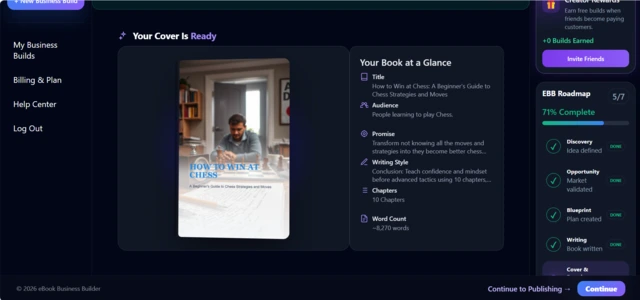
The screenshot above shows Cover & Brand within the EBB workflow—product presentation positioned after the manuscript is complete and before the eBook moves toward publishing.
By this stage, the roadmap reflects five completed stages of product development. The cover you see is not arbitrary—it represents the audience, promise, and product identity the workflow built from the first stage forward.
Cover, Title, Audience, and Promise
A reader should be able to understand the basic product proposition from the combination of title, cover, audience signals, and promise—without reading the manuscript or lengthy sales copy.
These elements work together:
- Title — names the product and often hints at the topic or outcome
- Cover — provides the visual context that makes the title feel credible and relevant
- Audience — reflected in design choices that signal who the product serves
- Promise — communicated through subtitle, imagery, and the overall visual message
This connection traces back through the entire EBB Method. Discovery explored who you could serve. Opportunity validated that direction. Blueprint defined the audience, problem, and transformation. Writing delivered the content. Cover & Brand presents all of it visually—so the product proposition is clear before a reader opens the book.
When these signals align, the product feels trustworthy. When they conflict—a beginner-focused title on a corporate-looking cover, or a promise of simplicity on a cluttered design—readers notice the disconnect before they buy.
Visual Consistency Across the Business
An eBook should not exist visually in isolation. The cover establishes a visual direction—a palette, tone, and style—that can carry through the business assets created in later stages.
Visual consistency matters because customers encounter your product in multiple places: a landing page, an email, a social post, an ad. When those touchpoints share a coherent visual identity, the business feels intentional. When they do not, it feels assembled rather than designed.
Cover & Brand prepares the reader for what comes next in the workflow:
Cover & Brand → Publishing → Business Assets
Publishing makes the eBook available. Business Assets—landing pages, funnels, promotional materials—apply the visual direction established here across the business system. The cover is often the reference point for that consistency.
Establishing brand direction during Cover & Brand means later stages have a foundation to build on—not a blank slate requiring new design decisions under launch pressure.
A Professional Product Is More Than a Manuscript
There is a meaningful difference between two statements:
- "I wrote an eBook."
- "I created a digital product."
The first describes content. The second describes a product—something packaged, presented, published, and supported by a business system. Cover & Brand is where that distinction becomes real.
A manuscript is intellectual work. A digital product is intellectual work plus presentation, identity, and the infrastructure to bring it to market. Without Cover & Brand, you have words waiting to become a product. With it, you have something a customer can recognize, evaluate, and purchase.
This is exactly where the EBB Method moves from content creation toward business creation. Writing finished the content. Cover & Brand finishes the product presentation. Publishing, Business Assets, and Launch Marketing finish the business.
Treating this stage seriously—not as an optional design flourish—is what separates eBook authors from eBook business builders.
What Cover & Brand Produces
The Cover & Brand stage produces the visual and product identity needed to move the eBook forward in the workflow—toward publishing and the business assets that follow.
Outputs of this stage include:
- A finished eBook cover ready for publishing and promotion
- Visual direction that can extend across the business
- Product presentation that communicates audience, promise, and credibility
- A clear connection between the eBook and its intended reader
- A foundation for the business assets created in later stages
This stage does not produce a published eBook, a landing page, or a marketing campaign. It produces the visual identity the product needs before those stages can proceed effectively.
The manuscript from Writing and the cover from Cover & Brand together form the core product—the content and the presentation—that everything else in the business will support.
Cover & Brand as the Fifth Stage of the EBB Method
Cover & Brand is the fifth stage of the eBook Business Builder Method—the complete workflow for turning one idea into a published eBook and a functioning digital business.
Discovery → Opportunity → Blueprint → Writing → Cover & Brand
Each stage answers a distinct question:
- Discovery: What could I build?
- Opportunity: Is this worth building?
- Blueprint: What exactly should I build?
- Writing: How do I turn the plan into the actual eBook?
- Cover & Brand: How do I present the finished product professionally?
What follows—Publishing, Business Assets, and Launch Marketing—brings the product and business to market. But Cover & Brand completes the product itself: content plus presentation, manuscript plus identity.
Understanding where this stage sits in the progression helps you use it correctly: as the visual completion of the product, grounded in every strategic decision that came before it.
Next Step: Publishing
Once the manuscript and product presentation are ready, the next question is practical: how do you turn the finished eBook into a published product—available in the formats and channels your customers expect?
Publishing is the stage where content and cover become a deliverable product ready for sale. Writing created the manuscript. Cover & Brand created the presentation. Publishing makes it available.