
Writing
Execute your eBook blueprint—turning audience, structure, and transformation into a coherent manuscript that delivers on its promise.
Start Your eBook BusinessWrite the eBook
Writing is where the product plan becomes the actual manuscript. Everything before this stage—Discovery, Opportunity, and Blueprint—exists to make this work focused, deliberate, and aligned with a reader who has a real problem to solve.
The Blueprint defines the product. Writing turns that plan into the eBook. When audience, problem, transformation, concept, outline, and chapter structure are already established, the writing process stops being an open-ended search for what the book should be and becomes the execution of decisions already made.
Discovery asks: "What could I build?"
Opportunity asks: "Is this worth building?"
Blueprint asks: "What exactly should I build?"
Writing asks: "How do I turn that plan into the actual eBook?"
The goal is not simply to produce words. The goal is to create useful eBook content that moves the intended reader toward the promised outcome—chapter by chapter, section by section, until the manuscript is complete.
Writing should not be where you suddenly decide who the book is for, what problem it solves, or what each chapter should accomplish. Those decisions belong to the Blueprint. Writing executes them.
What Is eBook Writing?
In the eBook Business Builder Method, eBook writing is not a standalone creative exercise. It is the stage where product strategy and content plan become a coherent manuscript—a structured experience for a specific reader, not a collection of information dumped into chapters.
eBook writing involves turning planned elements into prose:
- Ideas expressed clearly for the intended audience
- Explanations that build understanding step by step
- Examples that make abstract concepts practical
- Instructions the reader can follow
- Transitions that connect one section to the next
- Chapter progression that moves toward the defined transformation
- A reader experience that feels intentional from start to finish
An eBook manuscript is more than word count. It is the delivery mechanism for the transformation defined during Blueprint—the before-and-after change the reader pays for. Every paragraph should serve that delivery, not merely fill space under a heading.
Understanding eBook writing in this context separates productive drafting from the common trap of writing extensively without producing a useful product.
Start With the Blueprint
The most important input to the Writing stage is the output of the Blueprint stage. A writer who begins without that foundation is not writing from a plan—they are rediscovering the product while producing it, which is slower, messier, and more likely to produce chapters that do not belong.
Blueprint → Writing
When you start writing, you should already have:
- The intended audience—a defined reader profile
- The reader problem—the reason the eBook exists
- The transformation—the before and after the book delivers
- The product concept—the integrated who, what, and why
- The outline—the sequence of chapters and major sections
- Chapter objectives—the purpose and outcome of each chapter
- Content architecture—how information flows within and across sections
Starting from the Blueprint prevents the eBook writing process from becoming open-ended. You know what each chapter must accomplish before you write the first sentence. That clarity is the difference between executing a plan and improvising a product.
For a practical walkthrough of drafting, editing, and finishing the manuscript, see our guide to the step-by-step eBook writing process.
If your blueprint is incomplete, return to that stage before drafting extensively. Return to the eBook Blueprint →
Write for the Reader, Not the Topic
One of the most common writing mistakes is treating the eBook as a container for everything the author knows about a subject. The result is often comprehensive but useless—full of information the reader does not need, in an order that does not match how they learn.
Weak approach: "I need to write everything I know about this topic."
Better approach: "What does this reader need to understand or do next?"
When you write for the reader, you constantly reference:
- What they already know—and what they do not
- The questions they are likely asking at this point in the book
- Their context—the situation that brought them to this eBook
- Their goals—what they want to accomplish
- Their obstacles—what has stopped them before
- Their desired outcome—the transformation the Blueprint defined
This connects directly to the audience and transformation established during Blueprint. You are not writing about freelancing in general—you are writing for the career-switcher who needs their first three clients. That specificity shapes every explanation, example, and instruction.
Write Each Chapter With a Purpose
Every chapter in the manuscript should have a job—a defined contribution to the overall reader transformation. eBook chapter writing is easier when that purpose was established during Blueprint and remains visible while you draft.
For each chapter, keep these questions in view:
- What does the reader need here that they did not have before?
- What problem does this chapter solve—or what part of the larger problem does it address?
- What should the reader understand afterward?
- What should the reader be able to do after completing this chapter?
- Why does this chapter come at this point in the sequence?
A chapter without a clear purpose tends to drift—adding information because it seems relevant rather than because it advances the reader's journey. Purpose-driven chapter writing keeps the manuscript focused and makes revision simpler because every section has a defined reason to exist.
When the Blueprint has already answered these questions, the writer's job is execution: producing the content that fulfills each chapter's defined role.
Turn the Outline Into Real Content
Writing an eBook from an outline is a translation process. The outline provides direction—the manuscript provides the substance that makes that direction useful to a reader.
An outline tells you what sections exist and in what order. A manuscript adds:
- Explanation—the reasoning and context behind each point
- Examples that make ideas concrete
- Application—how the reader puts concepts into practice
- Instruction—step-by-step guidance where the reader needs to act
- Transitions—connections between sections and chapters
- Useful detail—the depth appropriate for this audience and problem
Good writing expands the structure without losing it. You are not simply filling every heading with words until a word count target is met. Each section should earn its place by helping the reader understand, decide, or act.
If a section in the outline cannot support meaningful content for the defined reader, that is a signal to revisit the Blueprint—not to pad the manuscript with filler.
Build a Coherent Reader Journey
A finished eBook should feel like progression—not a stack of articles bound together. The reader should sense forward movement from the first chapter to the last, with each section preparing them for what comes next.
Chapter 1 → Chapter 2 → Chapter 3 → … → Reader Outcome
Building that journey requires attention to:
- Logical sequencing—concepts introduced before they are applied
- Transitions—explicit connections between sections and chapters
- Increasing understanding—each chapter builds on what came before
- Increasing capability—the reader can do more as the book progresses
- Avoiding repetition—saying the same thing twice without adding value
- Maintaining momentum—keeping the reader oriented and moving forward
This connects back to the content architecture defined during Blueprint. The architecture described how information flows; writing executes that flow in prose. When the journey is coherent, readers finish the book feeling they have arrived somewhere—not that they have read a collection of loosely related parts.
Make the Writing Useful
The strongest test of eBook content is usefulness. Does this section help the reader accomplish something they could not accomplish before—or understand something they genuinely needed to know?
Useful eBook writing helps the reader:
- Understand something that was confusing
- Solve a problem they have been stuck on
- Make a decision with more confidence
- Avoid a mistake that would cost them time or money
- Follow a process step by step
- Develop a skill through explanation and practice
- Achieve a specific outcome defined in the Blueprint
Usefulness is more concrete than "being engaging." An engaging paragraph that does not advance the reader's goal is entertainment, not product value. A clear, straightforward explanation that solves the reader's immediate question is exactly what a well-designed eBook should deliver.
During writing—and especially during revision—review each section against the transformation. Ask whether removing it would make the reader's path to the outcome harder. If not, the section may not be earning its place.
Write With Clarity and Structure
Clarity is not the enemy of depth. The most useful eBooks explain complex ideas in language the intended reader can follow—without oversimplifying to the point of uselessness.
Practical principles for clear eBook writing:
- Use direct language—say what you mean without unnecessary complexity
- Keep paragraphs focused on one idea
- Write headings that tell the reader what they will learn or do
- Include examples where they clarify an idea, not where they pad length
- Provide enough detail for the audience—neither too little nor overwhelming
- Use transitions so the reader always knows where they are and why
- Maintain consistent terminology throughout the manuscript
Sophisticated writing does not have to be complicated writing. The reader should always understand where they are in the book, what the current section is trying to accomplish, and why the information matters to their situation.
Structure supports clarity. When the Blueprint has defined the architecture, the writer's job is to make each section readable and purposeful—not to reinvent organization while drafting.
Using AI to Help Write an eBook
AI can play a meaningful role in the eBook writing workflow—but effective AI-assisted writing depends on the quality of the plan that comes before it. AI without direction produces content without purpose. AI with a clear Blueprint produces drafts that serve a defined strategy.
Useful roles for AI in eBook writing include:
- Expanding a defined chapter based on its stated purpose and objectives
- Developing explanations for concepts already identified in the outline
- Generating examples aligned with the intended audience
- Creating first drafts that the writer then evaluates and refines
- Restructuring sections to improve flow or clarity
- Identifying repetition across chapters
- Suggesting alternative wording for clarity or tone
- Supporting revisions after the initial draft is complete
AI should execute against a clear strategy rather than inventing the entire product without direction. The workflow exists precisely because product decisions belong to Discovery, Opportunity, and Blueprint—not to whatever a language model generates when asked to "write an eBook about marketing."
When AI writing is grounded in audience, problem, transformation, and chapter objectives, it can accelerate production significantly. When it is not, it often produces volume without usefulness—and volume without usefulness creates revision work rather than saving it.
AI Writing vs. Human Judgment
AI can generate language quickly. It cannot replace the creator's responsibility for whether that language actually serves the reader. Human judgment remains essential throughout the writing stage.
The creator is responsible for:
- Accuracy—ensuring claims, steps, and examples are correct
- Usefulness—evaluating whether content helps the reader toward the outcome
- Relevance—keeping material aligned with audience and chapter purpose
- Examples—choosing or verifying illustrations that fit the reader's context
- Tone—maintaining a voice appropriate for the audience
- Reader needs—prioritizing what matters to the person buying the book
- Originality—bringing perspective and insight AI cannot replicate from your expertise
- Final decisions—what stays, what goes, and what requires rewriting
This is not a case of AI being bad or humans being always better. It is a division of labor: AI can accelerate production; human judgment provides direction, context, evaluation, and final editorial control.
Readers may reasonably want to understand how AI was used in creating an eBook they purchase. Transparency about AI-assisted writing is a practical consideration, not a philosophical debate—and editorial oversight is what makes AI-assisted content trustworthy.
Develop a Consistent Voice
A full eBook manuscript spans thousands of words across many chapters. Without attention to consistency, it can feel like separate pieces written at different times—which undermines the sense of a single, coherent product.
Consistency across the manuscript includes:
- Terminology—the same concepts described with the same words throughout
- Tone—formal or conversational, but steady across chapters
- Level of explanation—matching what the defined audience already knows
- Point of view—consistent use of first, second, or third person
- Examples—aligned with the reader profile established in the Blueprint
- Reader expectations—delivering the kind of experience the product concept promises
A book should feel like one coherent product rather than chapters written independently and assembled later. The Blueprint and writing strategy established during earlier stages provide the reference point for consistency—when those are clear, maintaining voice across the manuscript is far more manageable.
Revision is where consistency is often finalized. Reading chapters in sequence—not in isolation—reveals shifts in tone, terminology, or depth that drafting alone may not expose.
How eBook Business Builder Handles Writing
eBook Business Builder carries the strategic context from earlier stages into Writing. The Writing stage does not begin from a blank page—it begins from a Blueprint that defines audience, problem, transformation, structure, and chapter objectives.
When you write inside EBB, the product decisions made during Discovery, Opportunity, and Blueprint remain visible and active. You are not generating a manuscript in isolation from the business you are building. You are producing the core product content within a workflow designed to keep every stage connected.
The interface reflects where Writing sits in the complete process. By the time you reach this stage, the roadmap shows the progression that got you here—and Writing is stage four because the strategic work is already complete.
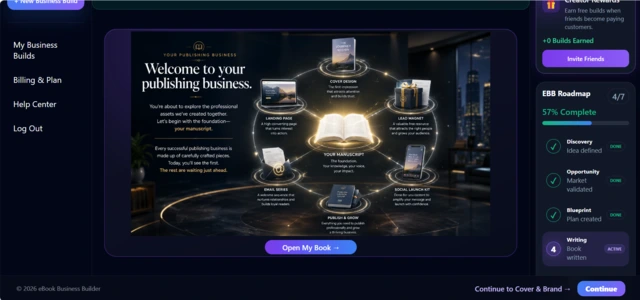
The screenshot above shows Writing within the EBB workflow—manuscript creation positioned after Discovery, Opportunity, and Blueprint. The roadmap visible in the interface reflects a deliberate sequence: product decisions first, content production second.
Discovery → Opportunity → Blueprint → Writing
Writing is the fourth stage because the audience, opportunity, and product plan have already been established. The writer executes the Blueprint—creating the manuscript that later stages will publish, brand, and bring to market.
What the Writing Stage Produces
The output of the Writing stage is the eBook manuscript—the core product content that everything else in the business will support and sell.
By the end of Writing, you should have:
- Completed chapters that fulfill their defined purposes
- Coherent content that reads as one product, not disconnected parts
- Consistent structure aligned with the Blueprint
- Reader-focused explanations appropriate for the defined audience
- Examples and applications that make the content practical
- A finished manuscript ready for the next stages of the workflow
"Finished manuscript" means the writing stage has produced the core product content—the words the reader will consume. It does not mean the eBook is ready to sell. Cover design, publishing preparation, business assets, and launch marketing come in subsequent stages.
The manuscript is the foundation. What follows builds the business around it.
Writing Is the Bridge to Cover & Brand
Once the manuscript exists, the product needs a visual identity. Readers encounter the cover and brand before they read a single page—and those elements communicate who the product is for and what it offers.
Blueprint → Writing → Cover & Brand
Writing completes the content. Cover & Brand gives that content a face—the design, visual identity, and presentation that turn a manuscript into a recognizable product.
The transition is natural: you cannot design an effective cover for a book whose audience, promise, and positioning are unclear. Because those elements were defined during Blueprint and executed during Writing, Cover & Brand has a solid foundation to work from.
When the manuscript is complete, the next stage develops how the product looks and feels to potential buyers. Explore Cover & Brand →
Writing in the eBook Business Builder Method
Writing is the fourth stage of the eBook Business Builder Method—the complete workflow for turning one idea into a published eBook and a functioning digital business.
Discovery → Opportunity → Blueprint → Writing → Cover & Brand → Publishing → Business Assets → Launch Marketing
Each stage builds on the one before it. Discovery explores possibilities. Opportunity validates and defines the direction. Blueprint decides what the product should be. Writing executes that plan into a manuscript. Cover & Brand, Publishing, Business Assets, and Launch Marketing bring the product to market.
If your blueprint is not yet complete, return to that stage before writing extensively. The quality of the manuscript depends on the quality of the plan. eBook Blueprint
Next Step: Cover & Brand
Once the manuscript is written, the next stage is creating the visual identity that turns the finished content into a recognizable product—the cover, brand elements, and visual presentation that communicate what the eBook offers before a reader opens it.
Writing delivered the content. Cover & Brand delivers the first impression.