
Opportunity
What you'll learn
This guide explains Phase 2 of every Business Build: Opportunity. You will learn why this phase comes after Discovery, what EBB analyses, how the Opportunity Report is formed, and why those insights matter before you commit to a Blueprint.
What is Opportunity?
Opportunity is the second phase of a Business Build. It takes the answers you provided in Discovery and turns them into a clear view of the market opportunity behind your idea — who the reader is, what problem is worth solving, how you can position your ebook, and whether the direction is strong enough to build on.
You do not write chapters here. You review strategic analysis so that Blueprint and Writing start from a validated direction rather than a guess.
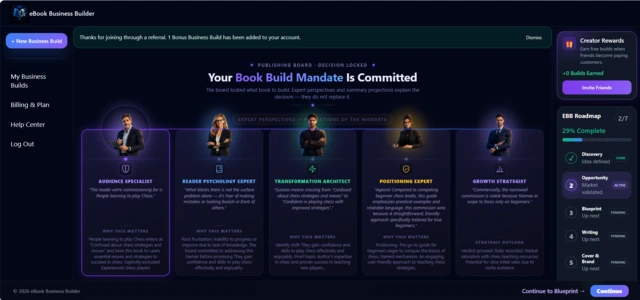
Why the Opportunity phase matters
Many digital products fail because creators start writing before they understand demand. A topic that feels exciting to the author can still miss the reader’s real problem, compete in a crowded space without a clear angle, or promise a transformation that is too vague to sell.
Opportunity reduces that risk. Before any manuscript is generated, EBB examines the market context around your idea — audience needs, problems worth solving, positioning, and business potential. You leave this phase knowing whether your direction is focused enough to build a complete business around.
That clarity improves everything that follows. Blueprint can commit to a chapter plan and business snapshot with confidence. Writing has a sharper promise. Cover & Brand and later assets speak to the same reader and outcome.
What EBB analyses
The Opportunity Report is not a checklist of features. It is a reading of your business idea through several lenses that matter before you invest time in a full build:
Market demand. Whether there is a meaningful need for a guide like yours, and how your topic sits in a space readers already search for help.
Audience needs. Who the primary reader is and what they are trying to achieve — grounded in the audience and transformation you described in Discovery.
Problems worth solving. Which pain point is sharp enough to motivate a purchase, and whether your idea addresses a frustration people will pay to resolve.
Competitive positioning. How your ebook can stand apart — not by listing every possible competitor, but by clarifying the angle that makes your offer distinct.
Value proposition. The clear promise you can make to the reader: what they get, who it is for, and why your approach fits that audience.
Business potential. How the idea can support a broader ebook business — including direction for monetization and growth — so you are not only writing a book, but building something you can launch.
What happens behind the scenes?
EBB combines your Discovery answers with AI analysis to produce personalized recommendations for your project. The report is shaped by your topic, audience, transformation, pain point, credibility, and goals — not a generic template applied to every user.
Advisor-style insights summarize the strategic picture so you can review positioning and direction before Blueprint. Nothing here requires you to run your own market research process; the platform organizes the analysis around the business you already described.
When you continue, those conclusions become inputs for Blueprint: primary audience, primary problem, desired transformation, method, and positioning. That is why Opportunity sits between Discovery and Blueprint — it turns raw intent into strategic certainty.
Tips for better results
Be specific during Discovery. Opportunity can only analyse what you gave it. Narrow topics and concrete readers produce sharper recommendations than broad, abstract answers.
Think about the audience rather than yourself. When you review the report, keep asking what the reader needs to hear — not only what you want to teach. Strong opportunities are reader-first.
Solve one problem exceptionally well. A focused promise usually outperforms a wide “everything” guide. If the analysis points to one dominant pain point, lean into it in Blueprint.
Common mistakes
Trying to target everyone. If the audience is “anyone interested in success,” the Opportunity analysis has little to sharpen. A defined reader makes positioning possible.
Choosing a market that is too broad. Broad markets are hard to own with a first ebook. Prefer a niche where you can be clearly relevant.
Ignoring the audience’s biggest pain point. Skipping or soft-pedaling the problem weakens demand signals and leaves Blueprint without a strong conflict to resolve.
What you'll have when you finish
When Opportunity is complete, you should leave with a clearer understanding of your market, your audience, your positioning, and the opportunity you are building. Those insights become the foundation for Blueprint — where EBB commits your business snapshot, chapter framework, and ecosystem plan.
For the phase that feeds this analysis, see Discovery . For a map of the full workflow, see the Complete User Guide .