Discovery
What you'll learn
This guide explains Phase 1 of every Business Build: Discovery. You will learn what Discovery is for, why your answers matter, how the seven questions work, and how to get the best results before Opportunity begins.
What is Discovery?
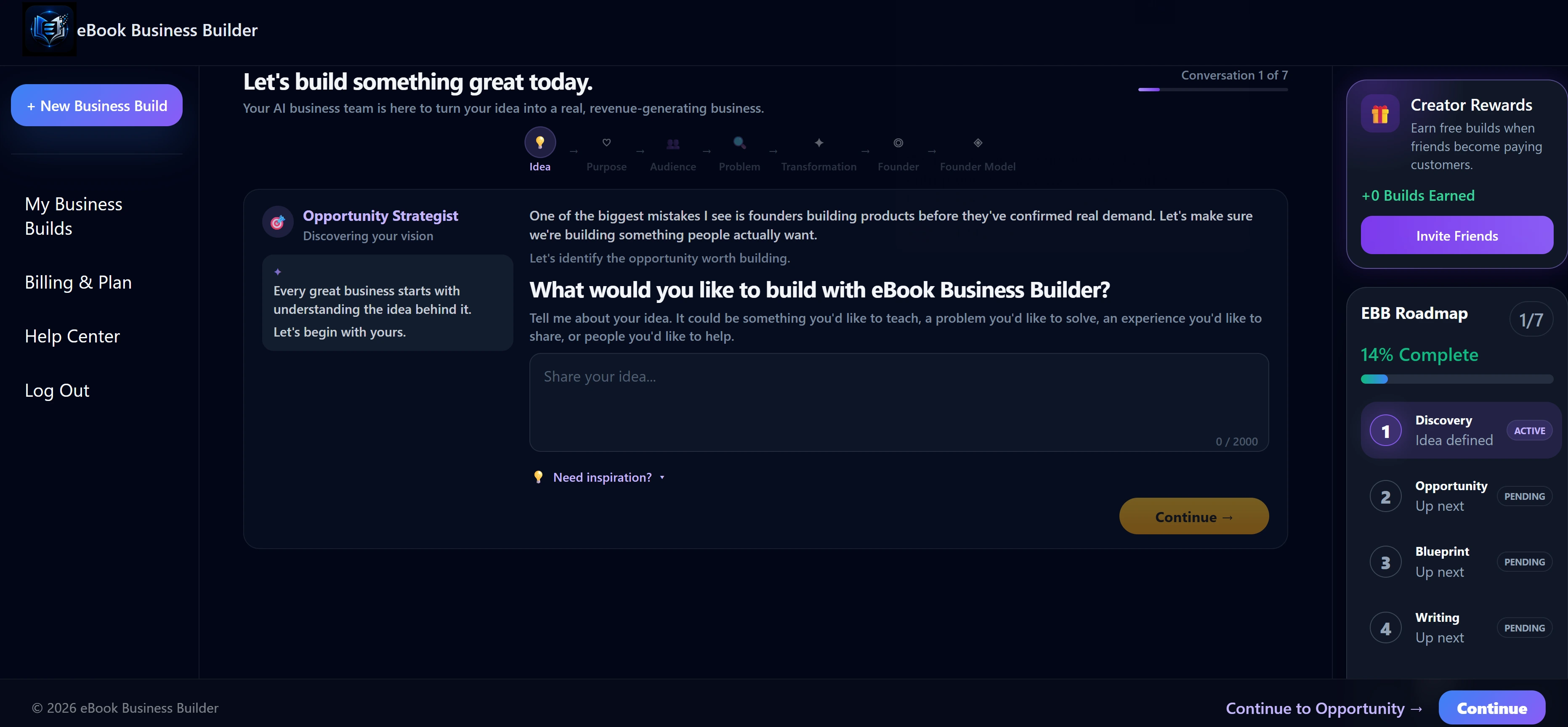
Discovery is the first phase of a Business Build. It is a guided conversation that captures the foundation of your ebook business: your topic, your reader, the transformation you want to deliver, the problem you solve, your credibility, your business goal, and how involved you want to be.
You answer seven questions one at a time. There is no blank document and no need for a finished outline. Your answers become the source of truth for Opportunity, Blueprint, Writing, Cover & Brand, and every phase that follows.
Why Discovery matters
Later phases do not invent a new business from scratch. They build on what you say in Discovery. Vague or generic answers produce vague positioning, weaker chapter structure, and less relevant writing. Clear, specific answers give EBB the detail it needs to generate a coherent strategy and manuscript.
Discovery is also where you define the reader’s journey — who they are today, what keeps them stuck, and what success looks like after they finish your ebook. That transformation language flows into Opportunity, Blueprint, Cover & Brand, and your marketing assets.
The Seven Questions
Each question focuses on one part of your business foundation. Answer in your own words. Short paragraphs are fine — specificity matters more than length.
- Passion (topic) What is the ebook about? Name the subject clearly enough that a stranger would understand the niche.
- Audience Who is the primary reader? Describe a real person or group — role, situation, or stage of life — not “everyone.”
- Transformation What outcome should readers achieve after finishing the book? Prefer concrete results over vague statements like “feel better.”
- Pain point What problem keeps that audience stuck or frustrated today? This is the tension your ebook addresses.
- Credibility What experience, learning, or lived insight qualify you to teach this topic? You do not need a formal credential — relevant experience is enough.
- Business goal What does success look like for you with this ebook business — income, brand, time freedom, or another clear outcome?
- Involvement How hands-on do you want to be as the business grows — highly involved, guided, or more automated?
What happens behind the scenes?
When you finish Discovery, your answers are saved to your Business Build project. EBB maps them into structured intelligence — creator mission, reader profile, desired outcome, and related attributes — that Opportunity uses to produce strategic analysis.
You do not need to manage that mapping yourself. Your job in Discovery is to answer clearly. The platform carries those answers forward so Writing, Cover & Brand, and later phases stay aligned with the same topic, audience, and transformation.
Tips for getting the best results
Write as if explaining your idea to a smart colleague who does not know your niche. Prefer concrete examples over buzzwords. Name a specific reader (“busy parents learning guitar after 40”) rather than a broad category (“beginners”).
For transformation and pain point, describe something observable — what the reader can do, decide, or stop struggling with — not only how they might feel. For credibility, mention real experience, even informal teaching or personal results.
Common mistakes to avoid
Being too broad. Topics like “success” or audiences like “everyone” give the platform little to work with. Narrow the niche and the reader.
Skipping the pain. A strong transformation without a clear problem weakens positioning. Name what is broken today.
Rushing through all seven answers. Discovery is short, but it sets the foundation for the entire Business Build. A few extra minutes here usually save rework later.
Writing for yourself only. Business goal and involvement are about you; topic, audience, transformation, and pain point should stay focused on the reader.
What you'll have when you finish
When Discovery is complete, your project has a saved set of answers that define the subject, audience, transformation, problem, credibility, business goal, and preferred involvement level. You are ready for Phase 2 — Opportunity — where EBB turns those answers into strategic analysis and positioning recommendations.
For a map of the full workflow, see the Complete User Guide . For how projects and balances work, see Business Builds Explained .