
Blueprint
What you'll learn
This guide explains Phase 3 of every Business Build: Blueprint. You will learn why a structured plan matters, how Blueprint connects Opportunity to Writing, what the plan includes, and why reviewing it carefully improves every phase that follows.
What is Blueprint?
Blueprint is the third phase of a Business Build. This is where EBB converts research into a practical business strategy. Discovery captured your intent. Opportunity clarified the market. Blueprint organizes both into a coherent plan that gives every later phase direction.
You are not writing chapters yet. You are confirming the business snapshot, chapter structure, transformation roadmap, and ecosystem plan that Writing, Cover & Brand, Publishing, Business Assets, and Launch Marketing will follow.
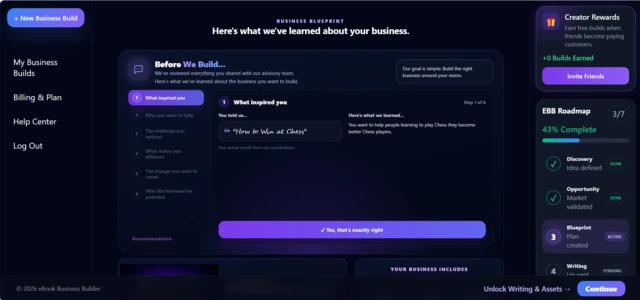
Why the Blueprint matters
Successful businesses are built from a clear plan rather than ideas alone. Without a Blueprint, content generation has no shared structure — chapters can drift, the cover can miss the promise, and marketing assets can speak to a different reader than the book.
The Blueprint brings together everything learned in Discovery and Opportunity and organizes it into a coherent strategy before content generation begins. Taking a few minutes to review it is one of the highest-leverage steps in the workflow: small corrections here improve Writing, branding, publishing files, and launch materials later.
Think of Blueprint as the bridge between strategy and production. Opportunity tells you the direction is sound; Blueprint tells every subsequent phase exactly how to build.
What the Blueprint includes
The Blueprint is a single committed plan. Its parts work together so your ebook and business stay aligned:
Business positioning. How your offer sits in the market — the angle that makes your ebook distinct and relevant to the reader you chose.
Target audience. The primary reader the plan is built for, carried forward from Discovery and refined through Opportunity so every chapter and asset speaks to the same person.
Core promise. The clear outcome your ebook commits to deliver. This promise guides chapter titles, cover messaging, and later marketing copy.
Customer transformation. The before-and-after journey for the reader — where they start, what changes, and what success looks like when they finish.
Product structure. The chapter framework and teaching sequence. Writing generates the manuscript against this structure rather than inventing a new outline from scratch.
Content direction. The method, teaching approach, and practical focus that keep the manuscript educational and useful — not generic filler.
Brand voice. Tone and presentation cues that Cover & Brand and business assets can echo so the finished package feels consistent.
Business strategy. How the ebook fits a broader ecosystem — including direction for assets and growth — so you are planning a business, not only a document.
What happens behind the scenes?
EBB analyses your Discovery answers and Opportunity insights to create a personalized Blueprint for your project. The plan is generated specifically for your topic, audience, transformation, and positioning — not pulled from a generic template shared across unrelated businesses.
When the Blueprint is ready, you review the business snapshot, transformation roadmap, chapter framework, and ecosystem view. Continuing from here commits that plan as the primary source of guidance for Writing and every remaining phase.
You do not need to assemble the strategy manually. Your job is to read carefully, confirm that the direction matches your vision, and only then move forward.
Tips for better results
Read the Blueprint carefully before moving on. Check the title direction, audience, promise, and chapter sequence. If something feels wrong, address it now — before a full manuscript is generated.
Make sure it accurately reflects your vision. The Blueprint should sound like the business you intended to build. If the positioning or transformation drifted, pause and resolve the mismatch before Writing.
Small improvements here improve every later phase. Clarifying one chapter purpose or sharpening the core promise can improve Writing, Cover & Brand, and launch assets without extra work later.
Common mistakes
Skimming the Blueprint without reviewing it. Treating this phase as a loading screen wastes the planning step. A few careful minutes here prevent misaligned writing later.
Moving on before the business direction feels right. If the audience, promise, or chapter plan does not match your intent, do not rush into Writing hoping it will correct itself.
Treating the Blueprint as optional. Later phases use this plan as their primary source of guidance. Skipping a real review is like building without drawings — possible, but far more expensive to fix.
What you'll have when you finish
After completing the Blueprint phase, you will have a clear business strategy, a structured plan, defined positioning, and a strong foundation for Writing, branding, publishing, and marketing. Every remaining phase uses the Blueprint as its primary source of guidance.
Next is Writing — where EBB generates your manuscript from this plan. For the phases that feed Blueprint, see Discovery and Opportunity .