Find the Opportunity
Understand local demand, customer needs, and where your carpet cleaning service fits.
A practical starting point for operators who want to launch a carpet and upholstery cleaning service with clearer quoting, equipment planning, and job workflow basics.
This page walks you through how to start a carpet cleaning business as a real local service—not just owning a machine. You will learn market analysis, equipment selection, quoting and pricing discipline, on-site job workflow, chemical safety, marketing, customer relationships, financial tracking, branding, and sustainable growth habits.
Understand local demand, customer needs, and where your carpet cleaning service fits.
Build budgeting and expense-tracking habits that keep margins visible as jobs increase.
Select extraction equipment, chemicals, and safety gear suited to your target jobs.
Quote jobs from costs and market context so pricing reflects the value you deliver.
Market through community engagement, social media, and local advertising channels.
Run a consistent on-site workflow from assessment through post-job follow-up.
Retain clients, strengthen your brand, and scale services without losing quality.
[object Object]
[object Object]
[object Object]
Homeowners and businesses continue to hire carpet cleaners when quoting feels fair, stains are handled carefully, and results are visible after the visit. Your first step is understanding the market in your area—not just the equipment, but customer needs, competition, and service gaps you can fill.
Many aspiring carpet cleaning entrepreneurs assume a good machine and a catchy name are enough to launch. Those elements matter, but understanding the market lays the groundwork for a business that meets real needs. Market analysis is about recognizing opportunities and understanding potential customers: who they are, what they value, and what challenges they face.
Competition in carpet cleaning is not only about other cleaning companies in your area—it is about understanding what they offer and how you can differentiate yourself. Review what existing services charge, which packages are popular, and how competitors market themselves. Gaps such as eco-friendly cleaning or specialized pet-stain treatments can help you tailor services to unmet needs.
A family with young children and pets may prioritize safe, non-toxic cleaning solutions. A corporate office may seek quick, efficient service that minimizes workflow disruption. Each potential client has different expectations. By getting to know your audience, you can offer personalized solutions that resonate with them.
[object Object]
[object Object]
Create a basic market analysis report for your local area. List competitors and note their strengths, weaknesses, services, and pricing structures. Identify whether your potential customers are primarily homeowners, renters, or businesses. Notice demographic trends that shape demand.
Practical takeaway: Spend an afternoon listing local competitors, their services, and pricing patterns. Summarize one gap you could fill—such as pet-stain treatment or eco-friendly products—before you buy equipment or publish quotes.
Strong job volume alone does not guarantee a healthy carpet cleaning business. Budgeting and expense tracking keep margins visible so you can price sustainably and reinvest as bookings grow.
Managing finances may feel daunting when you first start, but the fundamentals are approachable. Financial management involves three main components: budgeting, expense tracking, and profit analysis. Budgeting is a map for your spending. Expense tracking documents every step so you do not veer off course. Profit analysis is your reflection on what worked and what did not.
Start with anticipated income from regular clients, one-off jobs, or contracts. Then list potential costs: equipment purchases, maintenance, cleaning supplies, transportation, advertising, and your time. Categorize expenses into fixed costs that remain constant and variable costs that fluctuate, such as fuel or cleaning products.
Use accounting software or a simple spreadsheet to record expenses regularly. Set aside a specific time each week to enter costs. If cleaning supply expenses run higher than expected, explore alternative suppliers or bulk purchasing. Consistent tracking keeps your budget accurate and sharpens business decision-making.
Profit margin is the difference between what you earn from a job and what it costs to deliver it. The manuscript illustrates this with a carpet cleaning job charged at $150 where expenses total $75, leaving a $75 profit margin. Healthy margins allow reinvestment, savings for unexpected costs, and growth. If margins feel too thin, review pricing or costs without compromising service quality.
Practical takeaway: Draft a monthly budget with anticipated income and categorized expenses. Track one week of costs before your next quote so pricing decisions reflect real numbers—not guesses.
Your equipment and chemical choices shape every job outcome. Investing in reliable tools and understanding product applications protects results, safety, and long-term reputation—not just first impressions.
Many aspiring entrepreneurs believe they can start with minimal tools, assuming any machine will do. While you can technically clean carpets with basic equipment, unsatisfactory results, dissatisfied customers, and repair costs often follow. A low-cost machine that barely lifts dirt or leaves carpets damp long after you leave reflects poorly on your work and reduces referrals.
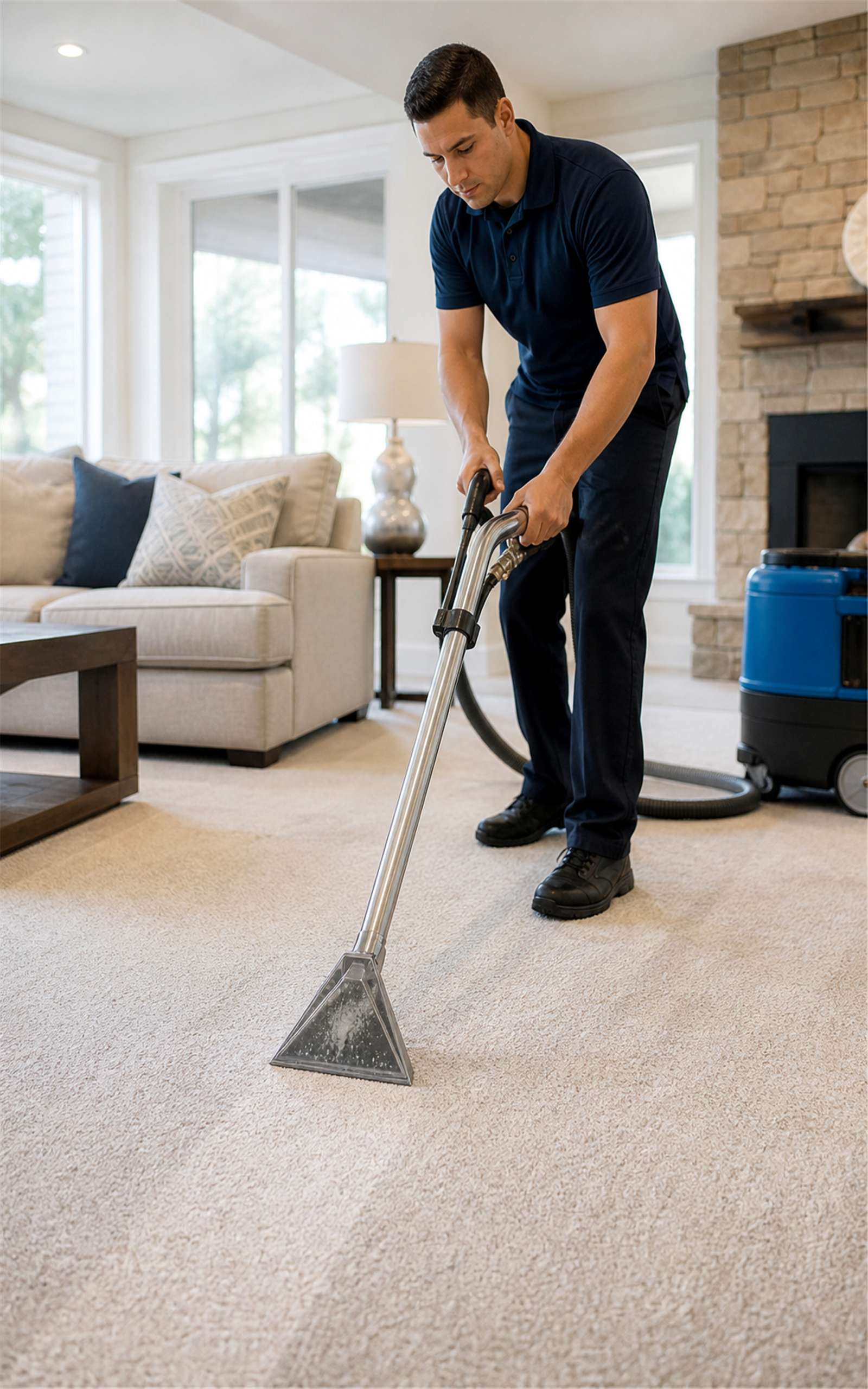
Extraction machines—carpet extractors—inject hot water mixed with cleaning solution into carpet fibers, loosen dirt, and vacuum dirty water back up. This method is effective for deep cleaning and removing stubborn stains and odors. Rotary cleaners use a spinning brush to agitate fibers and lift dirt, often for maintenance cleaning between deeper extraction jobs. For residential clients expecting thorough cleans, an extraction machine should be your priority. For commercial spaces with frequent upkeep, a rotary cleaner complements extraction work.
Not all cleaning products work the same way. Detergents break down dirt and grime but may be too harsh for delicate materials. Solvents dissolve greasy stains but can damage certain fibers if not rinsed properly. Enzymatic cleaners break down organic stains like food and pet messes but need time to work. Acidic cleaners remove mineral deposits or rust but require caution to avoid discoloration. Alkaline cleaners handle greasy and oily stains but can harm delicate fibers when used improperly.
Read product labels for intended stain types, suitable surfaces, and required safety gear. Create a chemical usage and safety reference documenting products, applications, and safety notes for quick on-site decisions.
A high-quality machine is only as good as how well you care for it. Regular maintenance—cleaning filters, checking hoses for blockages, and ensuring parts function correctly—prolongs equipment life and keeps performance consistent.
Practical takeaway: List the job types you plan to take first, then match equipment and chemical choices to those jobs. Read labels on every product before your first client visit and pack safety gear alongside machines.
Clients hire clear offers—not vague guesses at what a visit might cost. Quoting from real costs and local market context protects margins and signals the quality of your work.
When a potential client asks for a quote, underpricing in hopes of winning the job can backfire. Lower prices may signal inferior work, and failing to cover costs leads to burnout from working longer hours for less reward. Pricing should reflect the quality of your service and the costs associated with providing it—not competitor numbers alone.
Before quoting, know what it truly costs to clean a carpet. Direct costs include cleaning supplies, equipment maintenance, and labor. Indirect costs include transportation and marketing. The manuscript walks through an example: $20 on cleaning supplies, $10 on gas, and $50 of your time yields $80 total cost for a basic job. That figure is your baseline—not your final quote.
Observe what other carpet cleaners charge for similar services. This does not mean matching their prices exactly, but it provides context. If competitors charge between $150 and $200 for a standard carpet cleaning and your quote sits at $80, you may be undervaluing your service. Conversely, if you quote $250, you need to clearly articulate what makes your service worth that premium—such as eco-friendly products, satisfaction guarantees, or specialized stain treatment.
When analyzing competitors, note which packages are popular locally. Translate your services into offers clients can understand quickly: list each service, its costs, and proposed prices. Residential maintenance, whole-home deep cleans, and commercial upkeep can each become distinct offers with defined scope. Clarity helps clients book with confidence and protects you from scope creep on site.
[object Object]
[object Object]
[object Object]
Practical takeaway: Draft pricing guidelines listing your services, per-job costs, and proposed prices. Publish at least two named offers with written scope before your next quote conversation.
Quality equipment alone will not fill your schedule. Balanced marketing through community engagement, online presence, and local advertising connects your service with clients searching for dependable carpet cleaning.
Some operators rely only on newspaper ads and flyers, wondering why the phone stays quiet. Others embrace community engagement, social media, local events, and business collaborations—and their schedules fill faster. The difference is understanding multiple marketing channels and using them together rather than choosing one method and hoping it works.
Participating in community events or sponsoring local teams increases visibility and builds trust. People are more likely to hire someone they feel they know—someone who is part of their community. Familiarity breeds trust, and trust is invaluable in service industries.
Platforms like Facebook, Instagram, and even TikTok can connect you with potential clients. Share before-and-after photos, customer testimonials, and carpet care tips. Engaging content showcases expertise and encourages sharing, which amplifies reach. A simple video demonstrating stain removal effectiveness can spark inquiries from local homeowners.
Local newsletters and community magazines still reach loyal readers who notice local services. When you run a print ad, include social media handles and encourage readers to follow for tips, offers, and updates. This creates a connection between offline and online touchpoints.
Practical takeaway: Pick one community touchpoint and one online channel this week. Post a before-and-after photo or attend a local event so potential clients can see your work before they call.
Each job is unique, but standardized steps keep quality consistent. A mapped workflow from arrival through follow-up turns one-time visits into service clients recommend.
Many new entrepreneurs assume all cleaning jobs run the same way. Without a streamlined workflow, confusion and inefficiency creep in. Mapping fundamental steps creates a blueprint for consistent, high-quality service delivery on every site.
Juggling multiple jobs without a clear plan quickly becomes overwhelming. Scheduling helps manage time effectively and ensures each client receives adequate attention. When clients see methodical, efficient work, they trust your expertise and recommend you to others.
Have equipment and cleaning solutions ready and organized before arriving. Rummaging through your vehicle mid-job wastes time and disrupts rhythm—like a painter without brushes laid out before starting.
Develop a workflow plan tailored to jobs you encounter. Reflect on where the process flowed smoothly and where snags appeared. Adjust your plan after each visit instead of treating every job as isolated tasks.
Practical takeaway: Write your seven-step workflow on a card kept in your vehicle. Run through assessment, pre-vacuum, and inspection checkpoints on your next job—even a practice run for a friend or family member.
The job ends, but the relationship should not. Follow-up communication, brand consistency, and deliberate expansion turn one-time cleans into referrals and sustainable growth.
When you finish a job and pack up, the work is not truly done. Clients who feel appreciated and remembered are far more likely to book again and refer you. In carpet cleaning, where word of mouth is a powerful marketing tool, positive impressions often determine whether a job becomes a lifelong client.
Your brand is more than a logo—it is the entire impression your business leaves. Brand identity covers visual elements like logo, colors, and typography. Brand messaging defines your voice and tone. Marketing materials, customer experience at every touchpoint, and social proof through reviews all reinforce whether clients perceive you as reliable and professional. Consistency across platforms builds recognition and trust.
True scalability is not simply getting bigger. Consider diversifying services—upholstery cleaning, tile and grout cleaning, or carpet repair—after researching community demand and competition gaps. Draft a scaling plan covering market analysis, resource assessment, and quality control protocols so expanded services match the standards customers expect.
As you grow, hire thoughtfully. Identify critical roles that support expansion and invest in training so new team members share your commitment to quality. Implement customer feedback mechanisms to gauge satisfaction and guide scaling efforts aligned with client expectations.
Practical takeaway: Prepare a follow-up message template and send it after your next completed job. Review one growth option—such as upholstery cleaning or a second service area—only after your current workflow runs consistently.
Use this four-week outline to move from interest to first service calls. Each week builds on the last using steps supported by the Carpet Cleaning Business guide.
Confirm these essentials before you accept a paid carpet cleaning service call.
A carpet cleaning business is a local service where clients hire you to assess stains, quote jobs clearly, and deliver visible results on site—not simply owning a cleaning machine. Success depends on fair quoting, reliable equipment, chemical knowledge, consistent job workflow, and professional communication from first inquiry through follow-up.
List competitors and note their services, pricing structures, and marketing approaches. Identify whether your potential customers are homeowners, renters, or businesses. Look for gaps such as eco-friendly cleaning or specialized pet-stain treatment that you could fill with tailored services.
Essential tools include a carpet extractor for deep cleaning, a rotary cleaner for maintenance work, a vacuum for pre-cleaning, a spot cleaning machine for touch-ups, appropriate chemical solutions, and safety gear such as gloves, masks, and protective eyewear. Match equipment choices to the job types you plan to serve first.
Calculate direct costs—supplies, equipment maintenance, and labor—plus indirect costs like transportation. Research local competitor pricing for context, then set prices that cover costs and reflect the value you provide. The manuscript's $80 cost example ($20 supplies, $10 gas, $50 time) illustrates baseline calculation, not a final quote.
Underpricing can signal lower quality to clients and prevent you from covering costs or earning reasonable profit. Working longer hours for insufficient reward leads to burnout. Pricing should reflect service quality and business costs—not just the lowest number that wins a conversation.
A typical job flows through assessment and preparation, pre-cleaning vacuuming, spot treatment, the main cleaning method, post-cleaning inspection, final touches, and customer follow-up. Scheduling jobs with adequate time buffers keeps each step thorough rather than rushed.
Read product labels for intended stain types, suitable surfaces, and safety precautions. Match detergents, solvents, enzymatic cleaners, acidic products, and alkaline products to specific stain and fiber situations. Test unfamiliar products on inconspicuous areas and wear appropriate protective equipment.
Send follow-up messages after jobs, respond thoughtfully to feedback, maintain brand consistency across materials and touchpoints, and expand services or hire help only after researching demand and establishing quality control protocols. Sustainable growth balances new bookings with the service standards clients already trust.
This carpet cleaning business example was developed using eBook Business Builder—the workflow used to structure the guide, free lead magnet, offer assets, email series, and marketing content you see in the EBB Showroom below.
If you want to create your own eBook business around a topic you know, EBB walks you through research, writing, assets, and launch in a repeatable system.
Start Building with eBook Business Builder →The flagship guide covers carpet cleaning startup fundamentals—market analysis, pricing strategy, equipment selection, job workflow, customer relationships, marketing, chemical safety, financial management, branding, and scaling—in a structured eBook format.
[object Object]
A lead magnet helps readers evaluate whether carpet cleaning fits their market and identify sensible first steps before buying machines or taking jobs.
Many new operators buy equipment first without a quoting method, stain assessment routine, or plan for travel time and job setup.
Foundational first steps, common early mistakes to avoid, and a simple action plan readers can use before committing to equipment or clients.
Carpet Cleaning Startup Program
A practical flagship guide for readers ready to move from interest to action—with clear first steps and professional quoting and job delivery habits for carpet cleaning services.
Tools & References