Discovery
Explore what you could build, who it could serve, and where promising eBook directions may exist—before you write a single word.
Start Your eBook BusinessDiscover the Right eBook Opportunity
A successful eBook business starts before the first word is written. Long before you outline chapters or choose a cover, you need a direction worth pursuing—and that direction rarely appears fully formed on day one.
Discovery is the stage where you explore what could be built, who it could serve, what problems could be addressed, and where promising directions may exist. It is not about locking in a final product. It is about opening up possibilities grounded in real audience needs, your knowledge, and gaps in the market.
Whether you are looking for your first eBook business idea or evaluating several digital product ideas, Discovery gives you a structured starting point. You gather directions worth investigating—not commitments you cannot change later.
Every strong eBook opportunity begins here, with curiosity about what could help someone and clarity about who that someone might be.
What Is eBook Discovery?
eBook discovery is the process of finding promising topics, audiences, problems, and product directions before committing to the writing process. It sits at the very beginning of building an eBook business, when the most important work is exploration rather than execution.
During discovery, you might brainstorm eBook topics, consider different niches, reflect on problems you have seen people struggle with, or examine where your experience intersects with audience needs. The goal is not to immediately choose one idea and run with it. The goal is to discover directions worth exploring further.
Think of discovery as casting a wide but intentional net. You are looking for eBook concepts that feel specific enough to be useful and broad enough to develop into a complete product. A vague interest in "productivity" is a starting point—not a finished eBook idea. Discovery helps you move from vague interest toward concrete product directions.
This stage protects you from one of the most common mistakes in the eBook business: writing first and asking whether anyone wants the book later.
Where Do Good eBook Ideas Come From?
Good eBook ideas rarely appear out of nowhere. They tend to emerge from a combination of sources you can actively explore during discovery.
Knowledge and experience
What do you know that others find difficult, confusing, or time-consuming? Professional expertise, hobbies, life experiences, and hard-won lessons all contain potential eBook topics. The question is not whether you know something—it is whether that knowledge could help a specific audience accomplish something meaningful.
Audience questions
The questions people ask—on forums, in comments, in client calls, in support tickets—often reveal eBook opportunities. When the same question appears repeatedly, it may signal an audience problem worth solving with a structured guide.
Problems people struggle with
Some of the strongest digital product ideas come from observing friction: tasks people avoid, processes they get wrong, decisions they delay because they lack clear guidance. Problems create demand when the cost of staying stuck is high enough.
Interests and passions
Interest alone does not guarantee a viable eBook business, but passion sustains the work of building one. Discovery helps you test whether an interest you care about also connects to a real audience need.
Market gaps
Sometimes existing resources are outdated, too generic, too expensive, or poorly organized. A market gap is not always an empty category—it is often a place where current options fail to serve a specific audience well.
Strong eBook ideas often sit at the intersection of what you know, what people need, and what could deliver meaningful value. Discovery is how you find that intersection.
Finding the Right Audience
Every eBook serves someone—but "everyone" is not a useful audience. When you try to write for everyone, your message becomes vague, your examples feel generic, and your reader never quite believes the book was made for them.
Discovery asks you to define a target audience with enough specificity to guide every decision that follows. Who is your ideal reader? What situation are they in? What do they already know, and what are they struggling to figure out?
Consider the difference between these two audience definitions:
- Too broad: "People who want to be healthier."
- Specific enough: "Busy professionals in their 30s and 40s who want to improve their energy and sleep without overhauling their entire lifestyle."
The second definition immediately suggests content angles, tone, examples, and outcomes. It tells you who the reader is, what they need, and why a focused eBook would matter to them.
During discovery, you are not finalizing your audience forever. You are establishing an audience direction—enough clarity to evaluate whether an idea has potential, and enough specificity to distinguish one eBook concept from another.
Reader needs and audience problems should drive your thinking here. The more clearly you can describe who you are helping and what they are trying to overcome, the stronger your discovery output will be.
Finding Problems Worth Solving
One of the most useful shifts in eBook discovery is changing the question you ask.
Instead of asking, "What eBook should I write?", ask, "What problem could I help someone solve?"
Problems create context. They give your eBook a reason to exist beyond the fact that you find a topic interesting. When you anchor discovery in problems worth solving, you naturally move toward product ideas that serve a purpose.
Useful eBooks can help people:
- Learn something they need to know
- Accomplish something they have been putting off
- Avoid a costly or painful mistake
- Understand something that has confused them
- Make a decision with more confidence
- Improve something in their work or life
- Save time on a recurring task
- Make money or grow a business
- Reduce confusion around a complex topic
Not every eBook needs to promise a dramatic transformation. Some of the most successful digital products solve narrow, practical problems extremely well. Discovery helps you identify which problems are worth your attention—and which ones connect to audiences willing to pay for clarity.
When you evaluate potential eBook topics through this lens, weak ideas often reveal themselves quickly. A topic with no clear problem behind it is harder to market, harder to structure, and harder for readers to justify buying.
From Idea to eBook Concept
A raw eBook idea and a viable eBook concept are not the same thing. Discovery helps you move through a progression that turns a broad starting point into a specific product direction.
Topic → Audience → Problem → Desired Outcome → eBook Concept
Here is how that progression works in practice:
- Topic: Freelancing
- Audience: New freelancers transitioning from a full-time job
- Problem: They do not know how to find their first clients or price their work
- Desired outcome: Land two to three paying clients within 60 days
- eBook concept: A practical guide to finding first clients and setting initial rates for career-switching freelancers
Notice how the eBook concept at the end is far more specific than the original topic. It names who the book is for, what problem it addresses, and what the reader should be able to do after reading it.
This progression is one of the most valuable outputs of discovery. It transforms a general interest into a product direction you can evaluate, refine, and—when the time is right—validate during the Opportunity stage.
Exploring an eBook Niche
Choosing an eBook niche is one of the decisions that shapes everything downstream: your content, your marketing, your competition, and your pricing. Discovery is the right time to explore niche options before you commit.
A niche exists on a spectrum. At one end, you have broad topics like "business" or "health." Moving inward, you find niches like "email marketing for coaches" or "meal planning for shift workers." Further still, you reach sub-niches with even tighter audience and problem definitions.
A niche does not have to be tiny to be effective. It needs to be specific enough that a reader understands who the product is for and why it matters to them. "Marketing" is too broad. "Launch marketing for first-time eBook creators selling on their own website" is specific enough to build around.
During discovery, explore how narrowing affects your eBook concept:
- Does a more specific audience make the problem clearer?
- Does the niche align with your knowledge and credibility?
- Can you imagine what a reader in this niche would search for or ask?
- Does the niche feel large enough to support a business, not just a single sale?
Exploring niches during discovery keeps you from prematurely locking into a direction that is either too broad to stand out or too narrow to sustain a business.
Explore Before You Commit
One of the most valuable habits in eBook discovery is resisting the urge to fall in love with the first idea that sounds good.
Early ideas often feel compelling because they are familiar, not because they are strong. Discovery works best when you consider multiple possible directions—different audiences, different problems, different angles on the same topic—before choosing one to investigate further.
This is where the distinction between discovery and what comes next becomes practical:
- Discovery = possibilities. You are generating and comparing directions.
- Opportunity = evidence. You are testing whether a direction is worth building.
Exploring several eBook business ideas during discovery does not mean you are indecisive. It means you are doing the work that prevents expensive mistakes later. A direction that survives comparison with alternatives is far more likely to become a viable product than one you chose on impulse.
Give yourself permission to brainstorm freely, note several product ideas, and hold them lightly until the next stage provides evidence to support—or redirect—your choice.
Discovery Is Not Validation
This distinction matters throughout the eBook Business Builder workflow. Discovery and Opportunity are related, but they serve different purposes—and treating them as the same step leads to weak products and wasted effort.
Discovery asks: "What could I build?"
Opportunity asks: "Is this worth building?"
Discovery identifies promising directions. It produces eBook concepts, audience directions, and problem definitions worth investigating. It does not confirm that anyone will buy your book, that the competition is manageable, or that your positioning will stand out.
That is the job of Opportunity—the stage where you investigate audience demand, competition, positioning, and product potential with enough rigor to decide whether a direction deserves your full investment.
Skipping discovery means you may validate the wrong idea. Skipping opportunity means you may build something nobody wants. The workflow is designed so each stage prepares you for the next.
When you have identified directions worth investigating, the natural next step is to evaluate them. Explore the Opportunity stage →
How eBook Business Builder Handles Discovery
Most tools jump straight to content generation. eBook Business Builder begins differently—with Discovery as the first stage of the complete workflow.
Rather than immediately producing a manuscript, EBB guides you through a conversational discovery experience. You articulate what you could build: your knowledge, your audience direction, the problems you might address, and the product ideas that emerge from that exploration.
The process is designed to help you think clearly before you commit. Questions prompt you to consider your ideal reader, the outcomes you could deliver, and the eBook concepts that connect your expertise to audience needs. You are building the foundation that every later stage depends on.
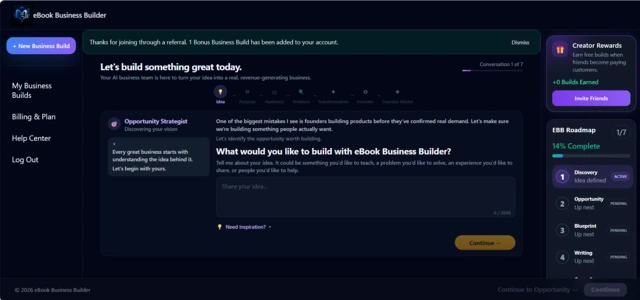
The screenshot above shows the Discovery experience in action—a guided conversation focused on what you could build, not on generating pages of content before you know what the product should be.
What you develop during Discovery feeds directly into the Opportunity stage. The directions, audience insights, and product concepts you articulate here become the raw material for validation—not the final product itself.
What Discovery Produces
Discovery does not produce a finished eBook. It produces a clearer direction for further investigation—the inputs that make the Opportunity stage meaningful rather than speculative.
By the end of discovery, you should have a stronger sense of:
- Potential eBook ideas worth exploring
- Audience direction—who the product might serve
- Problem direction—what friction or need the product could address
- An initial eBook concept with enough specificity to evaluate
- Information that can be tested and refined during Opportunity
This output is deliberately incomplete. A finished eBook is not the goal of this stage—a well-defined direction is. The stronger your discovery output, the more efficiently you can evaluate whether an idea represents a real eBook opportunity.
When you are ready to test what you have found, move forward to validate demand, competition, and positioning. Explore the Opportunity stage →
Discovery as the First Stage of the EBB Method
Discovery is the opening stage of the eBook Business Builder Method—the complete workflow for turning one idea into a published eBook and a functioning digital business.
The full method connects eight stages in sequence:
Discovery → Opportunity → Blueprint → Writing → Cover & Brand → Publishing → Business Assets → Launch Marketing
Each stage builds on the one before it. Discovery opens the process by exploring possibilities. Opportunity validates them. Blueprint structures the product. Writing, Cover & Brand, and Publishing create and deliver it. Business Assets and Launch Marketing turn the product into a business.
Understanding where Discovery sits in this workflow helps you use it correctly: as the foundation for everything that follows, not as a shortcut past the hard questions about audience, problems, and product direction.
Next Step: Opportunity
Once you have identified a promising direction, the next step is to determine whether that direction represents a real opportunity—whether there is audience demand, a defensible position, and enough potential to justify building the product.
Discovery gives you directions worth investigating. Opportunity gives you the evidence to choose one and move forward with confidence.