
Find the Opportunity
Understand who buys custom apparel and why operational clarity wins print jobs.
A practical starting point for printers who want to launch a t-shirt printing business with clearer product lines, print workflow basics, and repeatable order fulfillment habits.
This page walks you through how to start a t-shirt printing business as a real production and fulfillment operation—not just pressing designs at home without order clarity. You will learn who buys custom apparel, how a local print shop differs from a print-on-demand marketplace model, how to define product lines and print methods, how to build equipment and workflow routines, how to price from real production costs, how clients find you, and how to deliver dependable fulfillment teams and organizations trust.
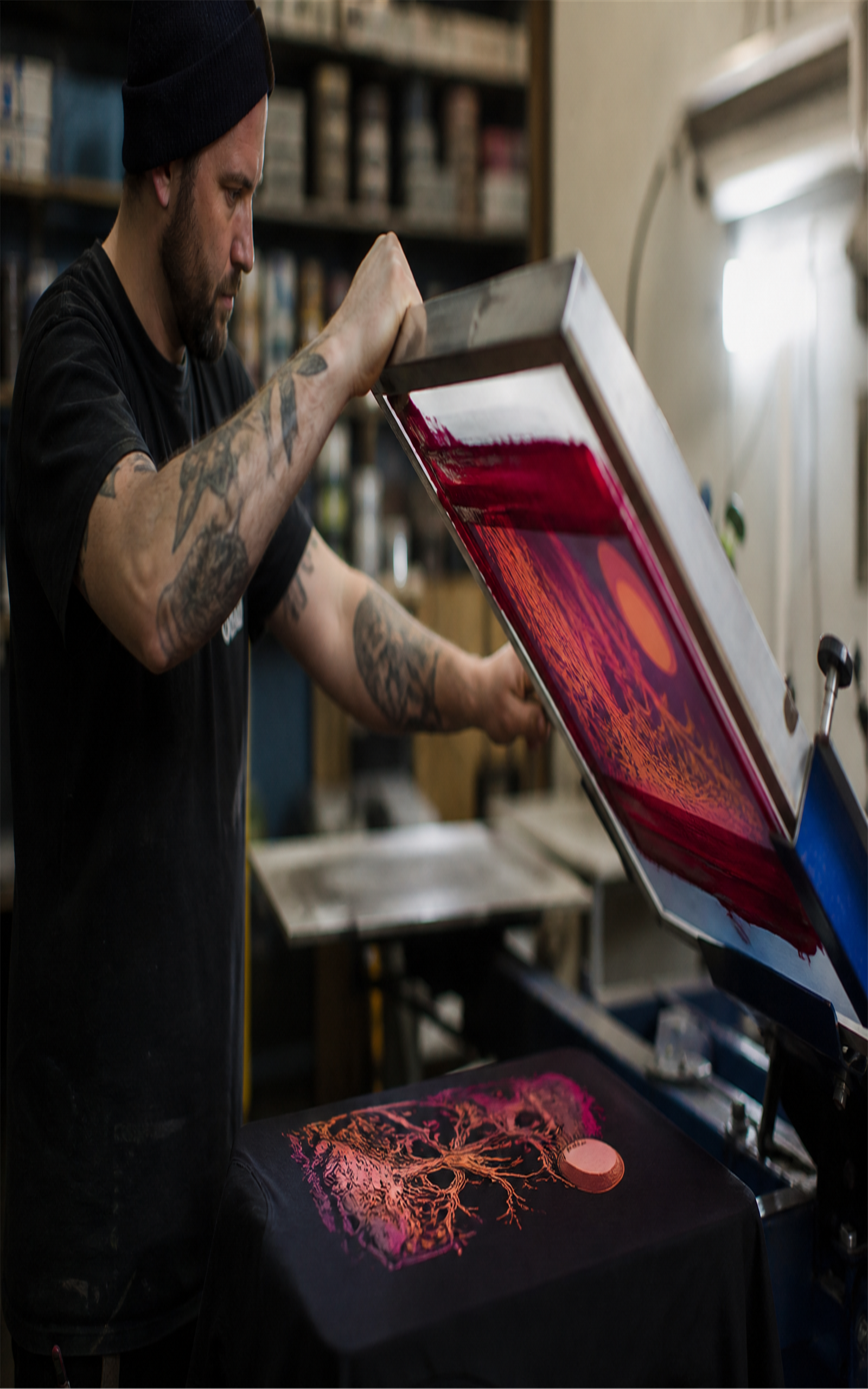
Understand who buys custom apparel and why operational clarity wins print jobs.
Decide between a production shop and a print-on-demand marketplace approach.
Define garments, print locations, and methods clients can compare on quotes.
Stage your shop setup and repeatable production routines from intake to pack-out.
Quote print jobs from measured setup, production, and fulfillment time.
Reach teams, events, and local brands with a controlled launch offer.
Improve intake accuracy and add capacity only when workflows hold.
A t-shirt printing business sells defined custom apparel jobs under written order terms—not open-ended "print whatever you send" work without quantity, deadline, or artwork clarity. You screen inquiries, confirm artwork and garment specs, quote from real production costs, run prints through documented workflow steps, inspect finished pieces, and deliver on timelines clients can plan around. Buyers pay for predictable quality, accurate sizing, color consistency, and turnaround they can trust for events, launches, and team orders.
That distinction matters. Owning a heat press or DTG printer is not the same as running a t-shirt printing business. Many capable printers accept jobs without proof approval, underprice setup and spoilage, or confuse a local fulfillment shop with a passive print-on-demand marketplace where a third party handles production. Schools, sports teams, small businesses, creators, and event organizers continue to hire local print shops when they need someone accountable for blanks, print placement, reprints, and delivery—but only when they believe the operator will communicate clearly, honor proofs, and ship complete orders on deadline.
This guide walks you through how to start a t-shirt printing business with professional habits: finding your opportunity, choosing between a production shop and marketplace models, defining product lines and print methods, building equipment and workflow routines, pricing from real costs, winning first clients, and growing with the operational discipline that defines a credible local printer. By the end, you should understand what the business is, what you need to prepare, and what to verify locally before accepting your first paid order.
Teams, schools, businesses, and event organizers buy custom apparel when they need branded garments on a deadline—reunion shirts, staff uniforms, fundraiser merch, conference giveaways, and creator drops. Your first step is understanding who you serve and what they expect from a professional printer, not assuming your design taste alone creates demand.
T-shirt printing businesses succeed when clients understand the order before production starts: garment style, sizes, print locations, ink colors, proof approval, turnaround, and what happens if artwork changes mid-job. Buyers are not simply purchasing blank shirts—they are purchasing confidence that the finished order will match the approved proof, arrive complete, and land before the game, launch, or event date.
Different clients bring different order sizes, deadline pressure, and repeat potential. Choose one primary profile for launch:
Often order matching tees or hoodies for seasons, clubs, and fundraisers. They compare on price per piece at quantity, reliable sizing breakdowns, and on-time delivery before events—not always on the flashiest print technique alone.
Need consistent brand colors, reorder-friendly SKUs, and professional invoices. They value proof accuracy and repeatability when the same logo returns on polos, tees, and tote bags season after season.
Prioritize visual impact, short-run flexibility, and fast communication. Deadlines are immovable; incomplete size runs or color shifts can damage trust faster than on a casual one-off order.
Observe your local market: who do existing print shops serve well, and where do buyers still express frustration—slow proofs, wrong sizes, inconsistent color, or shops that disappear when a reprint is needed? Your opportunity often sits in operational clarity as much as in print quality.
Adjacent creative businesses with overlapping buyer journeys—such as those in the print-on-demand business guide, copywriting business guide, and freelance business guide—show how defined product lines and professional intake sustain merchandise revenue. Custom apparel sits at the center of many brand launches; knowing when to handle production yourself versus refer complex jobs is part of the business model.
Practical takeaway: Write one paragraph describing your ideal first client and the order type you want most—twelve-piece team runs, fifty-piece business reorders, or twenty-four-piece event merch. List three questions they will ask before hiring—and make sure your future intake form answers them.
Before you buy equipment or publish prices, decide whether you are building a local production and fulfillment shop—or primarily selling designs through third-party print-on-demand marketplaces. The skills overlap, but the economics, client relationships, and daily work differ sharply.
In this model, you control the full job: sourcing blanks, preparing artwork, printing, quality control, folding, packing, and delivery or pickup. Clients hire you for accountability—when a team needs forty-two shirts in six sizes by Friday, you are the operator responsible for making that happen.
Garment quality, ink or transfer choices, turnaround promises, reprint policies, packaging, local pickup, and direct client communication from quote through delivery.
Equipment, blank inventory or supplier relationships, workspace, consumables, spoilage reserves, and labor time for setup, production, and fulfillment.
You want local B2B and group orders, repeat team clients, higher per-job revenue, and the ability to fix mistakes without waiting on a distant fulfillment partner.
In a marketplace model, you upload designs to platforms such as Etsy integrations, Shopify apps, or standalone POD providers. When a retail customer orders a single shirt online, the platform or partner prints and ships it—often with your brand on the packing slip but not your hands on the press.
Design creation, niche selection, listing copy, storefront branding, and marketing traffic—not physical production timing or garment handling.
Margin per unit, direct quality inspection, rush reprints, and the client relationship after checkout. Platform fee structures and base costs define your ceiling.
You want low inventory risk, digital-first selling, and audience-driven merch without operating a print floor. Strong listing and marketing skills matter more than press skills.
This guide focuses on starting a t-shirt printing business as a production and fulfillment shop—the model where order intake, print workflow, and quality control are your daily work. If marketplace storefronts and niche design shops fit your goals better, read the print-on-demand business guide for listing workflows, storefront setup, and digital delivery habits. Many operators eventually run both: a local shop for group orders and a POD storefront for passive single-unit sales—but launching both at once splits focus before either workflow is reliable.
Some production shops later add a POD storefront for designs that do not fit local minimums—niche graphics, fan merchandise, or experimental prints—while keeping group fulfillment on press in-house. The operational rule is separation: local clients get proof approvals, size-run accountability, and pickup or delivery promises you control personally; POD listings inherit platform economics and must not consume production slots reserved for deadline-driven team orders. Clarity between the two models protects reputation on the work that pays your overhead.
Avoid treating POD mockups as proof you can fulfill a fifty-piece team order on a two-day deadline. Marketplace fulfillment times, size availability, and color matching differ from local production. Conversely, do not assume a production shop can profitably serve one-off retail buyers at marketplace price points without a dedicated online funnel and shipping workflow.
Marketing-heavy creative businesses—including those in the copywriting business guide and freelance business guide—show how clear positioning wins buyers who could choose many providers. Your model choice is positioning: local fulfillment partner versus online design merchant. Lead with the model you are actually equipped to deliver today—not the hybrid story you hope to offer in a year.
Practical takeaway: Write one sentence declaring your launch model—local fulfillment shop or marketplace storefront. If you choose the shop model, list the first three order types you will accept and one order type you will decline until your workflow is proven.
Before you quote custom apparel, decide which garments, print locations, and production methods you offer—and document exclusions on every estimate. Clients need order specs they can verify against proofs, not vague "custom shirts" that expand when someone adds a sleeve hit or specialty fabric.
Each category on your menu should list garment options, standard print locations, and method limits:
Standard cotton or cotton-blend tees and pullover hoodies with front and back prints in agreed dimensions. Define max print size, number of colors, and whether sleeve or pocket hits are available at launch.
Bundle garment, one or two print locations, size collection spreadsheet, and delivery date. Best when clients need one invoice and one pickup or ship-to address before an event.
Polo shirts, work tees, and tote bags with logo placement standards. Emphasize color matching notes and reorder SKUs so repeat jobs do not require rediscovering specs from memory.
All-over sublimation, specialty performance fabrics, embroidery-heavy jobs, or oversized runs beyond your equipment capacity. Naming these upfront protects clients and your schedule.
Most startups master one primary method first:
Do not advertise every method on day one. Clients prefer honest capability limits over a menu that produces inconsistent results across techniques you have not tested.
Not every request fits your launch menu. Use intake questions to filter jobs early:
Written scope prevents the most common apparel disputes:
Businesses that scope carefully before quoting—like those described in the print-on-demand business guide for listing clarity—reduce friction because buyers understand inclusions before money changes hands. Physical print shops follow the same rule: a signed proof beats a verbal "you know what I mean."
Practical takeaway: Draft a one-page product menu with at least four garment categories, three print locations, and your launch method. Add five exclusions or refer-out notes. If a client could still ask "can you also print on…?" without a clear answer, tighten the language before publishing prices.
A t-shirt printing business runs on two foundations: equipment matched to your accepted methods, and a production workflow that turns approved proofs into packed orders without missed sizes or mystery color shifts. Under-documented settings and skipped quality checks erode margins faster than any competitor's lower per-piece price.
Invest in core production capacity first; add secondary tools when repeated jobs justify the cost:
Track consumable cost per job—ink, film, transfer vinyl, pretreat, and spoiled blanks—in your pricing model. Waste on learning runs is production cost, not a silent personal expense.
Professional fulfillment follows a repeatable sequence:
Team coaches, office managers, and event leads notice details beyond ink on fabric:
Intake should collect size breakdowns in writing, billing contact separate from artwork approver, delivery address, and whether missing sizes should hold the full order or ship partial with backorder notes. Surprises on delivery day—wrong count, wrong color, or missing youth sizes—destroy trust on high-visibility team orders.
Define a pre-pack checklist matched to your method: registration alignment, ink opacity, wash-durability spot checks on test scraps, correct SKU labels, complete size run, and clean garments free of press marks or lint. Compare the packed stack to the intake quantity line by line—not from memory.
Practical takeaway: Run one practice order through your full workflow—from intake form to packed delivery—before accepting a paying client. Note every missing step, unrecorded setting, or size-count error, and fix those before your next quote goes out.
Clients buy completed orders on deadline—not the lowest per-shirt number that ignores setup, spoilage, and your time preparing artwork. Pricing should reflect the full cost of the documented job, not a rate copied from a national chain you cannot verify.
Consider every cost category that applies to your shop model:
Small runs carry disproportionate setup cost. A twelve-piece order with a three-color front may not price like twelve times a single-color one-off. Build minimum order quantities or setup fees that cover pre-press honestly—buyers prefer transparent setup lines over artificially low per-piece rates padded with hidden fees later.
Per-piece tier tables work when clients understand quantity breaks. Package pricing suits team and event orders where one invoice should include garments, two print locations, and size collection support. Separate line items for garments, print labor, setup, and rush fees help business clients approve budgets internally.
Publish rush policies: what deadline triggers a rush fee, how many production slots you hold for standard turnaround, and what happens when artwork approval arrives late. Print shop labor is schedule-locked; a job that misses proof approval Tuesday cannot fairly displace a confirmed Thursday team order without a documented rush agreement.
Include payment terms, deposit requirements on custom orders, reprint liability when client-approved proofs print correctly, and restocking limits on blank returns. Custom apparel is made-to-order; clarity on non-refundable deposits prevents disputes when a client changes mind after blanks are ordered.
Track actual setup minutes, spoilage count, and per-piece production time on every early job against your estimate. Adjust templates based on real results. Service businesses with similar cost discipline—such as those in the freelance business guide—emphasize quoting from measured effort, not competitor guessing.
Practical takeaway: Build a pricing spreadsheet with blank cost, setup minutes, production rate, spoilage percentage, and overhead allocation. Complete it for your next three quotes, then compare projected costs to actuals after each order ships. Refine before scaling marketing spend.
Trust drives hiring decisions in custom apparel. Coaches, office managers, and organizers choose printers who return proofs quickly, honor signed approvals, and deliver complete size runs on deadline—not whoever sends the vaguest low bid.
Avoid discount-heavy advertising without workflow discipline behind it. Turnaround promises you cannot keep damage reputation on visible team orders faster than a modest launch discount builds it.
Creative product businesses with similar launch dynamics—such as those in the print-on-demand business guide—show how sample quality and clear product lines convert browsers into buyers. The operational pattern translates: clients hire printers they believe will deliver the approved proof on the agreed date.
Practical takeaway: Land your first three orders through direct outreach to one team, one local business, and one event organizer who match your target profile—before spending on ads. Document every intake question they raise and refine your forms after each conversation.
Growth means adding orders and capacity only when proof accuracy, production settings, and fulfillment checklists stay consistent—not accepting every rush job because your calendar has a gap.
A sensible progression:
Adding production help introduces quality variance. Document visual standards with photo examples, run joint QC on early jobs together, and review estimate-to-actual time and spoilage monthly. One bad batch on a visible team order can undo a season of referral goodwill.
Track metrics that matter: spoilage rate, on-time delivery percentage, proof approval turnaround, repeat client count, referral source, and jobs completed per week at your agreed standard—not vanity metrics like social followers alone. Fix intake and workflow gaps before marketing harder.
When you are ready to add passive online revenue, revisit the print-on-demand business guide to layer a marketplace storefront onto a proven production skill base—without confusing the operational standards your local clients depend on.
Practical takeaway: After your first ten completed orders, identify your most common spoilage cause and your strongest referral source. Fix the workflow or intake issue before adding a second press, method, or production helper.
Use this four-week outline to move from interest to a controlled first order. Each week builds on the last for a t-shirt printing business launch.
Confirm these essentials before you accept a deposit or order blanks for your first paid print job.
A t-shirt printing business is a production and fulfillment operation that accepts defined print jobs—custom apparel for events, teams, brands, and organizations—and delivers finished garments on agreed timelines. Success depends on clear product lines, documented print methods, accurate order intake, quality control, and pricing built from real production costs—not hobby-level printing without scope or turnaround clarity.
A production or fulfillment shop buys blanks, prints in batches or on demand locally, and controls quality, turnaround, and customer relationships directly. A print-on-demand marketplace model uploads designs to third-party platforms that print and ship individual orders with minimal inventory—but also less control over margins, quality, and brand experience. This guide focuses on running a real print shop; see the print-on-demand business guide for marketplace storefront strategy.
Most startups begin with one primary method matched to their target orders: screen printing for larger runs and team apparel, direct-to-garment (DTG) for small custom batches and full-color designs, or heat transfer and vinyl for short runs and personalization. Choose based on your client profile, minimum order expectations, and equipment budget. Master one workflow before adding secondary methods.
Requirements vary by country, state, county, and city. Most operators need business registration, a general business license, sales tax registration if selling taxable goods, and appropriate zoning if working from home or a commercial space. Verify local rules for home-based production, signage, and any environmental requirements related to inks and chemicals before accepting paid orders.
Capture garment style, sizes and quantities, print locations, ink or thread colors, artwork files with resolution notes, deadline, delivery method, and proof approval requirements on every quote. Written intake prevents the most common disputes: wrong sizes, color mismatches, missing backs or sleeves, and rush fees that were never discussed. Require signed approval on proofs before production starts.
Build pricing from blank garment cost, setup time, production minutes per piece, ink or transfer consumables, spoilage allowance, packaging, shipping or delivery, overhead, and margin. Screen printing spreads setup across quantity; DTG and heat transfer carry higher per-piece costs on small runs. Test prices in a spreadsheet using your measured production rates—not competitor guesses from another market.
Follow a repeatable sequence: inquiry and artwork screening, written quote with proof timeline, client proof approval, pre-production checklist, print run per documented settings, quality inspection, fold and pack, and delivery or pickup confirmation. Track each order stage so rush jobs do not displace committed deadlines without explicit client agreement.
Start with a defined client profile and controlled launch. Reach local buyers through search listings, school and league relationships, designer referrals, and portfolio samples on real garments. Professional intake forms, signed proofs, and reliable turnaround convert interest faster than vague low bids or marketplace-style mockups alone.
This t-shirt printing business example was developed using eBook Business Builder—the workflow used to structure the guide, free lead magnet, offer assets, email series, and marketing content you see in the EBB Showroom below.
If you want to create your own eBook business around a topic you know, EBB walks you through research, writing, assets, and launch in a repeatable system. See how business assets fit together and launch marketing for your eBook business to understand the full EBB build model.
Start Building with eBook Business Builder →The flagship guide explains how to start a t-shirt printing business—production shop fundamentals, product line clarity, print workflow, order intake, pricing, and client communication—in a structured eBook format.
Chapters walk readers through evaluating the opportunity, choosing between fulfillment shop and marketplace models, defining garments and print methods, building equipment and workflow routines, pricing from real production costs, winning first clients, and growing operations without sacrificing proof accuracy or turnaround reliability.
First Prints & Order Intake — a lead magnet that helps readers evaluate whether t-shirt printing fits their skills and identify sensible first steps before accepting paid orders.
Many operators start printing without order intake discipline, proof approval habits, or a clear distinction between running a local shop and selling through print-on-demand marketplaces.
Foundational first prints, common early mistakes to avoid, and a simple action plan readers can use before committing to client orders or equipment upgrades.
Can produce decent prints but unsure how to intake team orders, approve proofs, or quote jobs professionally.
Prepared with the fundamentals needed to screen artwork, document order scope, run test prints, and deliver a controlled first client job.
T-Shirt Printing Startup Program
A practical flagship guide for readers ready to move from interest to action—with clear first steps and professional fulfillment habits for dependable custom apparel production.
Tools & References